
OCTOBER 29, 2026 - 5 MIN READ
AI scales our worst habits (and our cloud bills)
- Artificial Intelligence
- Cloud Cost Management (FinOps)
- Data Governance

Jason BaerSenior Manager, Customer Solutions Architecture, Capital One Software
How AI speeds up SQL and self-serve data
In my last post, I wrote about how AI is the ultimate force multiplier for data professionals. By automating data preparation, writing pipelines and instantly debugging complex SQL, AI frees us from the tedious toil of the "data janitor." It elevates us to strategic partners who can focus on building innovative data products rather than untangling legacy code.
But perhaps the biggest win is democratization. We have finally empowered the business to self-serve. Today, a non-technical user can ask a natural language question like "Show me our top 10 products by sales in Q3," and an AI agent translates that into a functional SQL query instantly. Day 1 of this new reality is beautiful. We are moving faster than ever.
The "compute reflex" behind oversized warehouses
But let’s talk about Day 2.
When these pipelines are initially deployed, they are usually beautifully tuned. But data is not static. Volume grows, distribution shifts and query patterns evolve. Eventually, a pipeline fails or a business analyst's query hangs for twenty minutes.
As practitioners, let's be honest: When you are under a deadline, nobody has the time to refactor complex logic on the fly. We just want our workloads to finish. The quickest fix is what I call the "compute reflex," where we bump the Snowflake warehouse size up a tier, hit run and move on with our day. It solves the immediate pain, but it treats a symptom rather than the disease, leading straight into a massive "set it and forget it" trap.
Why AI-generated SQL drives up Snowflake costs
This is where the double-edged sword of AI democratization cuts deep. I have heard a familiar concern echoing from data leaders recently: AI didn't just speed up data engineers, it also unleashed a flood of non-technical users into the data warehouse, which is driving cloud bills through the roof.
The core issue is that AI language models optimize for plausibility and functionality, not computational efficiency. When an LLM generates SQL, it frequently relies on unpruned tables, misses necessary partition filters or leans on computationally heavy window functions when a simple aggregation would suffice. This creates a double-spend effect where you are now paying twice for inefficiency. First, you pay LLM API tokens to generate the query. Then, you pay massive cloud compute costs to execute a brute-force, unoptimized query on your data warehouse.
This is thescaling paradox. In the past, the damage of bad SQL was naturally rate-limited by how fast a human could type it. Now, AI can generate thousands of unoptimized, expensive queries a minute. AI is a force multiplier for writing code, but it has accidentally become a force multiplier for our worst engineering habits.
Extreme efficiency requires continuous governance
The solution is not to lock down the data warehouse or take AI away from business users. Instead, we should treat FinOps as a first-class engineering discipline.
You can no longer rely on static warehouse sizing. A "Large" warehouse that makes sense on Monday might be severely over-provisioning on Thursday, or it might be painfully undersized when an AI agent kicks off a massive batch of automated reports on Friday. True efficiency requires intelligent guardrails like automated query profiling, table pruning and dynamic warehouse rightsizing.
Automating Snowflake rightsizing with Capital One Slingshot
You could write custom Python scripts to monitor warehouse utilization, spot idle clusters and handle rightsizing every time data volume changes. But babysitting compute entirely defeats the goal of extreme efficiency.
As an early pioneer among major banks to move entirely to the cloud, Capital One faced these exact Day 2 scaling hurdles head-on. When off-the-shelf tools fell short of our needs, we built Capital One Slingshot, a data management and cost-optimization platform designed to eliminate performance bottlenecks and autonomously manage warehouse spending.
Within Capital One, Slingshot transformed how our data teams operate. Instead of digging through query history by hand, our teams use Slingshot's automated recommendations. The platform flags oversized warehouses, inefficient schedules and unused tables, attaching a clear dollar savings to each recommendation.
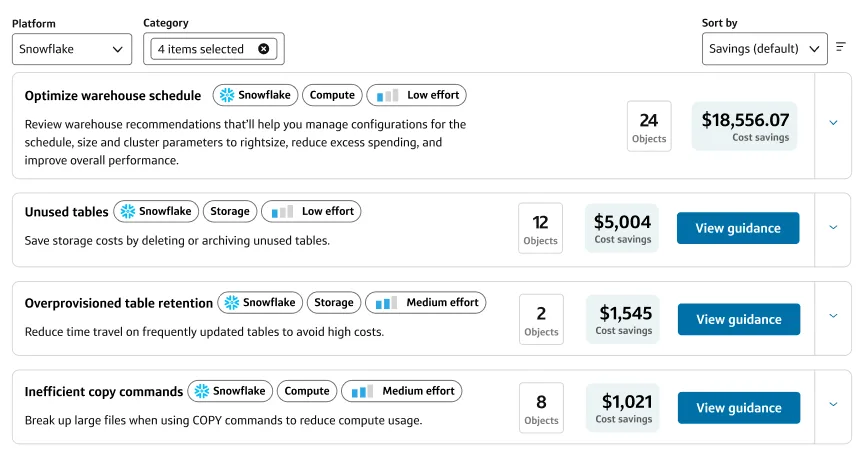
Figure 1: Slingshot recommendations for rightsizing warehouse schedules and cleaning up unused storage.
By providing deep visibility into workload drivers and automating governance, the platform has saved over 50,000 hours of manual engineering effort, reduced overall compute spend by 29% against projections, and driven a 43% decrease in cost per query. We used Slingshot's Value Report to track those metrics, proving that query volume could climb without our warehouse bill doing the same.
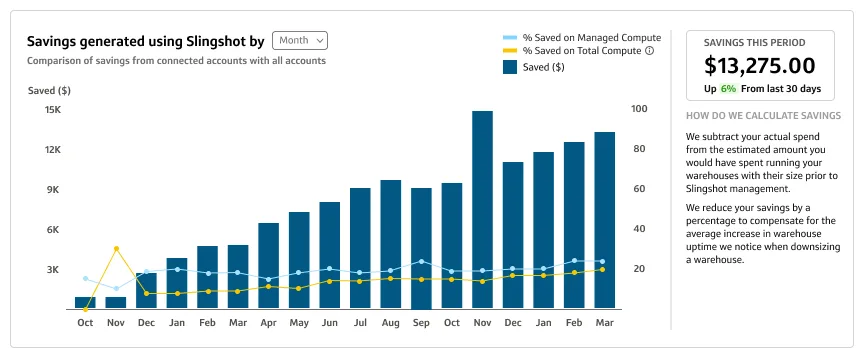
Figure 2: Monthly or weekly cost comparisons across connected accounts and all accounts.
Crucially, it gave our business teams the confidence to safely onboard over 400 new use cases without risking runaway cloud bills, freeing our engineers to focus on strategy and architecture rather than manually tuning clusters.
Balancing AI adoption with cloud costs
AI is generating code faster than ever, but is your warehouse configured to handle the volume?
I’d love to hear from other data leaders. How are you balancing the speed of natural language querying with the reality of cloud compute costs? Let’s chat in the comments below, or connect with me on LinkedIn.
Jason Baer
Senior Manager - Customer Solutions Architecture, Capital One Software
Jason is a Senior Manager of Solutions Architecture at Capital One Software. With over 20 years of consulting experience in data engineering and customer success, he has helped clients across diverse industries, including retail, higher education, healthcare and finance. Before joining Capital One, he served as a Senior Solutions Engineer at Sync Computing, and prior to that, spent four years at Databricks as a Customer Success Engineer.
Footnotes
DISCLOSURE STATEMENT: © 2026 Capital One. Opinions are those of the individual author. Unless noted otherwise in this post, Capital One is not affiliated with, nor endorsed by, any of the companies mentioned. All trademarks and other intellectual property used or displayed are property of their respective owners.