
NOVEMBER 17, 2026 - 7 MIN READ
Benchmarking Snowflake Adaptive Warehouses at scale: Empirical insights from tens of millions of production query runs
- Artificial Intelligence
- AI Observability
- Cloud Cost Management (FinOps)
- Data Observability
- Data Governance

Neeraj MuppidiSenior Manager, Software Engineering, Capital One Software
Since 2017, Capital One has scaled Snowflake into one of the world's largest deployments, running millions of daily queries across petabytes of data for thousands of active users. Operating at this scale leaves no room for assumptions. As a long-standing Snowflake partner and power user, our engineering teams rigorously test new capabilities against live production workloads before rolling them out.
When Snowflake introduced Adaptive Warehouses (opens in new tab), my team set out to evaluate how per-query dynamic resource allocation performs across enterprise workloads compared against tuned static warehouses. We executed a large-scale benchmark study across dozens of production warehouses in our primary enterprise environment, analyzing tens of thousands of unique query parameterized patterns. To ensure statistical parity, we matched run counts equally, comparing over 11 million executions on standard compute against an equal sample on adaptive compute, totaling tens of millions of query runs. We excluded stored procedures, bulk ingestion, unload jobs and queries with high cache reuse to evaluate raw compute performance.
In this post, I’ll break down what we discovered: where adaptive compute delivered breakthrough gains, where trade-offs emerged and our architectural recommendations for data platform teams.
Fleet overview: Performance acceleration, credit netting and memory stability
Operating at enterprise scale, our core goal was to test whether Snowflake's dynamic query allocation would translate to faster runtimes and net credit savings. The results were clear.
Across tens of thousands of query patterns evaluated, over 80% executed faster on adaptive compute. The fleet weighted average runtime dropped from nearly 10 seconds to just over 3 seconds, meaning queries executed roughly 68% faster overall.
This latency collapse yielded significant macro-level efficiencies across our infrastructure:
Compute hours saved: Fleet execution time dropped by more than two-thirds, saving tens of thousands of compute hours.
Net credit reduction: Despite the higher unit compute rate, average credits per query dropped by roughly 15%, resulting in a double-digit percentage reduction in total credits and saving tens of thousands of net credits across the fleet.
Concurrency and queue elimination: Fleet queue duration dropped from thousands of hours to under 40 hours, achieving a greater than 99% reduction in queuing delays.
Spill mitigation: Dynamic sizing reduced average local storage spill by over 10%, while remote storage spill was cut by more than half.
By dynamically allocating memory based on data volume, queries that previously overflowed fixed nodes completed in memory, avoiding costly disk spills.
Performance by workload: DML transformations vs. DQL analytical reads
My team isolated how adaptive compute handles different operational patterns, separating our fleet into approximately 10 million analytical read executions and over 1 million transformation executions across thousands of distinct query patterns.
While both operational categories benefited, heavy data transformations captured the largest economic return:
DML transformations: Workloads ran nearly 70% faster, finishing in roughly 15 seconds compared to almost a minute on standard compute. This delivered over 14,000 compute hours saved and a double-digit percentage credit reduction, saving over 11,000 net credits.
DQL analytical reads: Queries ran over 60% faster, completing in under 1.5 seconds compared to roughly 4 seconds on standard compute, generating thousands of compute hours saved and thousands of net credits saved.
Transformations involve complex joins, sorts and writes that bottleneck on static clusters. Adaptive Warehouses allocate memory and elastic compute at the exact execution stages where transformations demand it, finishing pipelines rapidly and surrendering resources.
The runtime tier shift and the sub-minute cost paradox
One of our most critical engineering findings focuses on runtime tiers. The efficiency curve of Adaptive Warehouses is highly non-linear, creating what I call the sub-minute cost paradox.
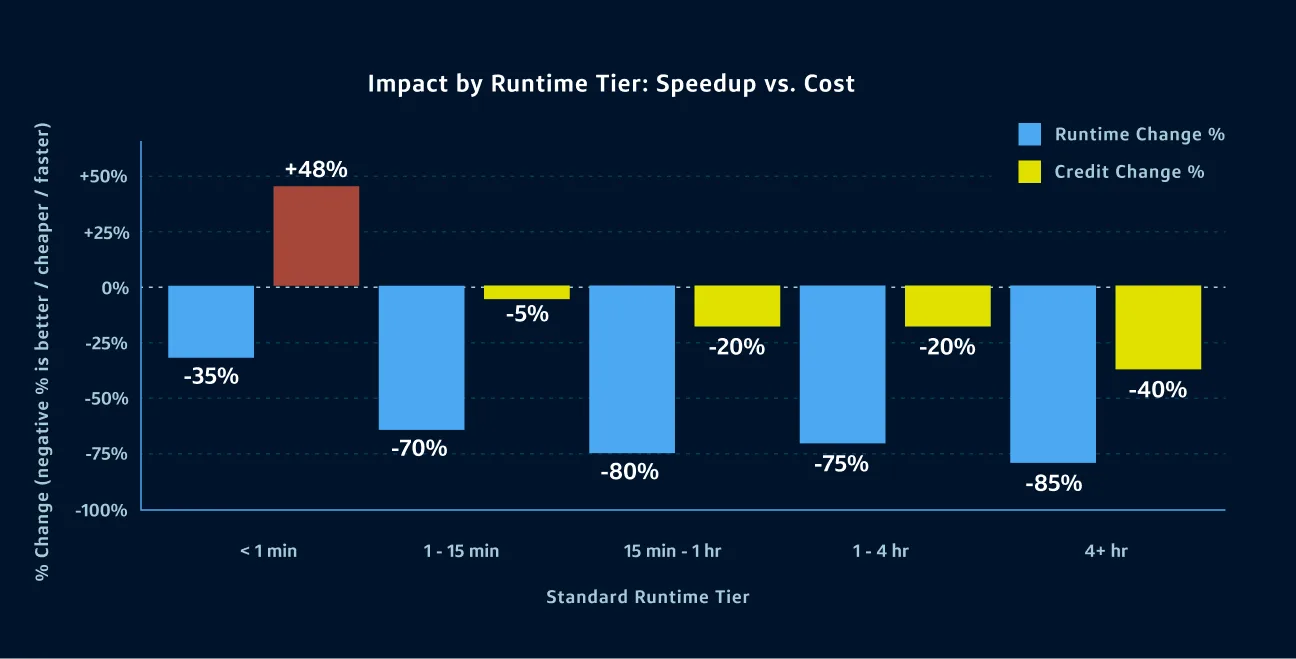
Note: Metrics are derived from internal production benchmark data and have been rounded for illustrative purposes.
For intermediate and long-running queries (1 minute to 4+ hours), adaptive compute delivered a clear win across both speed and cost:
Workloads ran 70% to 85% faster across every tier exceeding one minute.
Credits consumed per query dropped between 5% to 40%, with the longest workloads (4+ hours) seeing the steepest credit reductions. Overall, the 15-minute to 1-hour tier generated the largest financial return across the fleet.
Because these workloads completed so much faster, long-running jobs virtually disappeared from our system. Runs taking 15 minutes to 1 hour fell by more than 75%, runs taking 1 to 4 hours dropped by over 90%, and runs exceeding 4 hours plummeted by roughly 99% from hundreds of executions down to single digits.
However, the sub-minute tier revealed a clear operational boundary where speedup does not equal cost savings:
For queries running under 1 minute on standard warehouses (which represented the vast majority of our overall volume), execution was roughly 35% faster.
Despite this speedup, credit consumption per query increased by 48%, resulting in an aggregate net increase in credits consumed across this specific tier.
When a query naturally finishes in under two seconds, the compilation and routing overhead of adaptive compute cannot overcome the higher unit compute rate. The query finishes faster, but the efficiency window is too narrow to offset the baseline price premium.
Diagnosing regressions and benchmarking internal rightsizing
In our analysis, roughly 10% of query patterns exhibited regressions, defined as running over 5% slower on adaptive compute. My team categorized these into four primary root causes:
Short query overhead: Nearly half of classified regressions occurred on sub-2-second read queries, which slowed due to adaptive orchestration and provisioning overhead.
DML write overhead: Roughly a fifth of regressions stemmed from write-heavy operations where commit coordination and metadata serialization dominated runtime.
Data volume shifts: A subset of queries scanned significantly more data during the adaptive window due to underlying table partition growth.
Spill and resource contention: A small fraction encountered temporary local memory pressure or environmental variance.
Crucially, nearly a third of these slower queries were actually cheaper, indicating the adaptive engine chose an economical, less parallelized execution plan. Across all regressed queries, the net savings from improving queries outweighed regression penalties by more than 8-to-1. Furthermore, over 95% of all regressions were concentrated in queries that ran in under one minute on standard warehouses.
We also benchmarked Snowflake Adaptive Warehouses against Capital One Software's existing automated rightsizing algorithms across an isolated sample of over 1 million runs. Adaptive compute achieved a roughly 70% faster runtime with an incremental 5% cost reduction. This comparison validated two points: our internal resource governance already operates near maximum economic efficiency, and Snowflake Adaptive Warehouses can still extract dramatic latency reductions from an already optimized platform baseline.
When we partnered with the Capital One Card division to validate these findings across their top production warehouses (consisting primarily of Gen1 warehouses alongside Gen2 instances), more than half of the warehouses recorded runtime improvements exceeding 50%, replicating our benchmark results in live financial operations.
Architectural takeaways for data leaders
Based on tens of millions of query executions, here are my architectural takeaways:
Target heavy DML pipelines first: The highest return lies in scheduled transformation pipelines and staging layers, where pipelines run roughly 70% faster and total credit consumption meaningfully drops.
Isolate sub-minute micro-queries: Do not route high-throughput, low-latency lookups to adaptive warehouses unless speed is your sole SLA, as unit cost premiums outpace runtime savings.
Eliminate multi-cluster overhead: Use adaptive compute to remove warehouse sprawl and sizing guesswork while cutting queue delays to near zero.
To give our engineering teams a repeatable, deterministic way to choose between Standard, Gen2 and Adaptive compute, we synthesized our benchmark telemetry into a sizing decision framework based on query complexity and workload predictability:
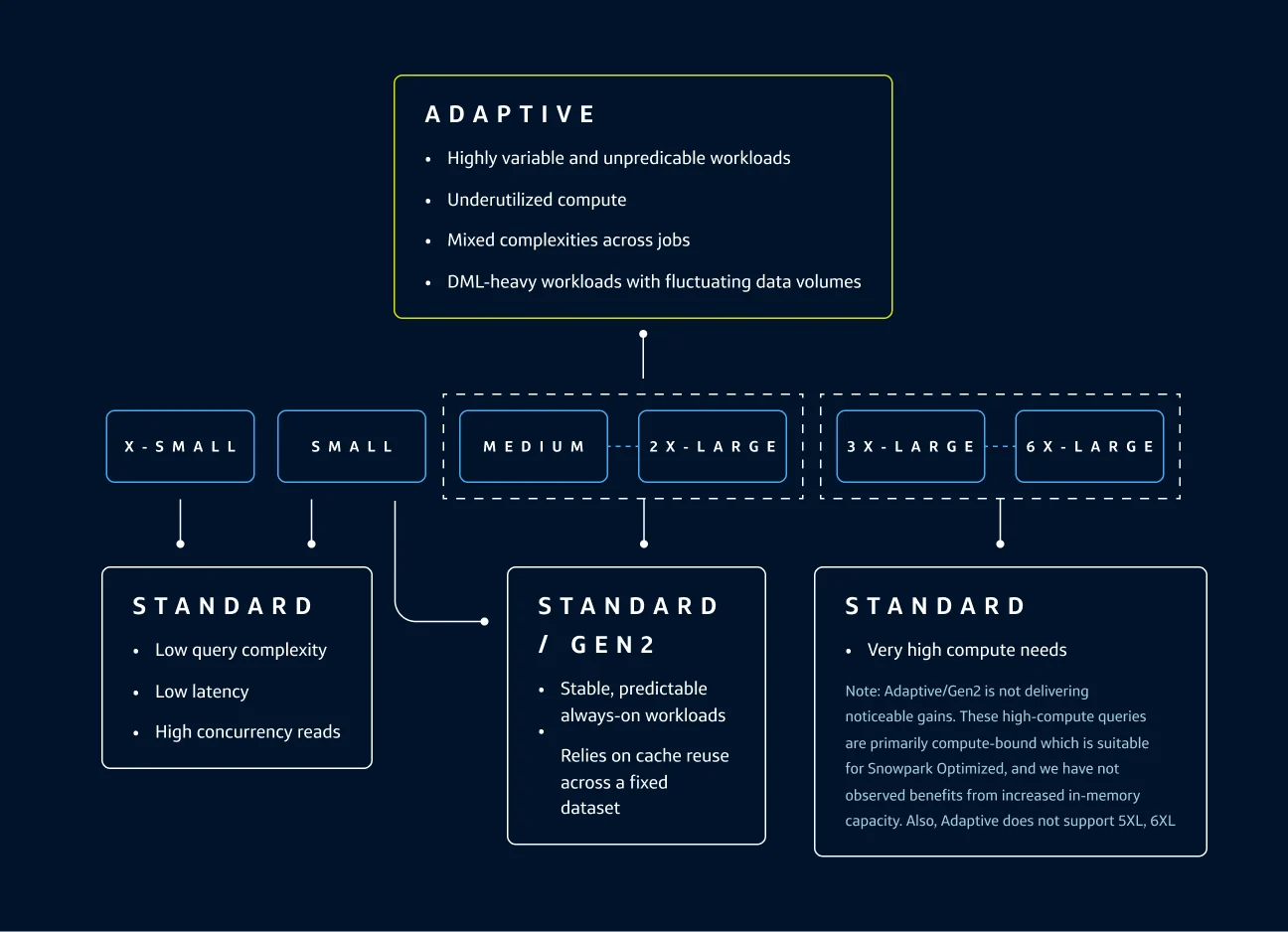
Our workload routing breaks down across four distinct profiles:
X-Small to Small (Standard): Best suited for low-complexity, low-latency workloads with high-concurrency read patterns. These micro-queries run too quickly to offset adaptive orchestration overhead.
Medium to 2X-Large (Adaptive): The clear sweet spot for adaptive compute. Ideal for highly variable, unpredictable workloads, underutilized compute instances, mixed-complexity job streams and DML-heavy transformations with fluctuating data volumes.
Small to 2X-Large (Standard / Gen2): Best for stable, predictable, always-on workloads that rely heavily on cache reuse across fixed datasets.
3X-Large to 6X-Large (Standard): Recommended for massive compute-bound workloads. At this tier, queries are primarily CPU-bound rather than memory-constrained, meaning Adaptive and Gen2 configurations do not deliver noticeable performance gains relative to their cost.
Reallocating efficiency: Fueling enterprise AI innovation
Compute optimization should never be viewed solely as cost cutting. In our organization, compute hours saved and credits recovered are directly reinvested into our foundational AI roadmap.
My team is maximizing this newly unlocked capacity to accelerate Snowflake Cortex deployment, specifically Cortex Analyst and Cortex Code. By constructing customized semantic view architectures on top of our Snowflake foundation, we are providing the domain skills necessary for thousands of active users to query enterprise data directly using natural language.
Through empirical testing, engineering discipline and our close partnership with Snowflake, Capital One Software continues to pioneer scalable, cost-effective architectures that power enterprise AI.
Neeraj Muppidi
Senior Manager - Software Engineering, Capital One Software
Neeraj is a seasoned data engineering leader with over 13 years of experience designing and developing large-scale data warehouse solutions. At Capital One, he leads data engineering initiatives leveraging technologies like Snowflake, Amazon Redshift and Teradata to support enterprise data platforms managing over 60 petabytes of data. He holds Snowflake SnowPro Core and Advanced: Architect certifications and is passionate about driving innovation, optimizing data platforms and applying emerging technologies to solve complex business challenges.
Footnotes
DISCLOSURE STATEMENT: © 2026 Capital One. Opinions are those of the individual author. Unless noted otherwise in this post, Capital One is not affiliated with, nor endorsed by, any of the companies mentioned. All trademarks and other intellectual property used or displayed are property of their respective owners.