
FEBRUARY 12, 2026 - 5 MIN READ
Databricks Lakebase: Unifying OLTP and OLAP in the Lakehouse
- Data Architecture
- Data Engineering
- Slingshot

Sachin SethTechnical Writer, Product Marketing, Capital One Software
How serverless PostgreSQL breaks down the transactional-analytical divide
For decades, data teams have faced a fundamental architectural choice: optimize for fast transactions or deep analytics, but rarely both. OLTP databases like PostgreSQL excel at millisecond writes and ACID guarantees, while data warehouses and lakehouses power complex queries across terabytes. The result? Fragmented architectures with nightly ETL jobs, data duplication, governance gaps and the operational overhead of managing multiple systems.
| Category | OLTP (transactional) | OLAP (analytical) |
|---|---|---|
Goal | Run the business | Analyze the business |
Focus | Recent operational data | Historical data |
Data pattern | Frequent, millisecond-level writes and updates | Bulk loads with large-scale, read-heavy queries |
Response times | Milliseconds | Seconds to hours |
Data volumes | MBs to GBs | GBs to TBs and beyond |
Query complexity | Simple queries | Complex queries |
The growing pressure points
Modern enterprise applications face demands that expose this split:
Real-time operational decisioning: Credit approvals, fraud detection and inventory allocation need both transactional consistency and instant access to historical patterns.
Concurrent user workflows: When hundreds of analysts and business users interact with the same datasets, write contention and lock escalation become critical.
Governance at scale: Managing access policies, audit trails and data lineage across separate OLTP and OLAP systems multiplies complexity and risk.
Multi-row, multi-table ACID operations: Business logic that requires
BEGIN ... COMMITacross multiple tables (ledgers, inventory, audit logs) is first-class in Postgres but is orchestrated piecemeal in most lakehouses.
Enter Databricks Lakebase
Lakebase fundamentally changes the equation. Lakebase is a fully-managed, serverless PostgreSQL service that runs inside the Databricks platform. It GA’d last week and now brings genuine OLTP capabilities into the lakehouse, while maintaining the analytical power users rely on.
Designed for low-latency (<10ms) and high-throughput (>10,000 QPS) transactional workloads, Lakebase is ready for AI real-time use cases and rapid iterations.
What makes Lakebase different
Native platform integration
No VPC peering, PrivateLink endpoints or firewall rules to configure
Databricks users and groups automatically map to Postgres roles
OAuth-backed identity flows seamlessly between OLTP and OLAP workloads
Serverless economics
Auto-scales under load, scales to zero during idle periods
Eliminates idle database costs and over-provisioned capacity
Pay only for actual compute consumption
Zero-maintenance operations
Automated minor releases, security patches and failovers
Rolling updates with no downtime windows
No replica management or backup orchestration
True PostgreSQL semantics
Row-level locks,
BEGIN ... COMMITtransactionsSupport for extensions like pgAudit
Logical decoding for CDC workflows
Full SQL compatibility
The unified architecture
This is how Databricks Lakebase bridges the gap between high-speed enterprise applications and the broader BI analytics platforms:
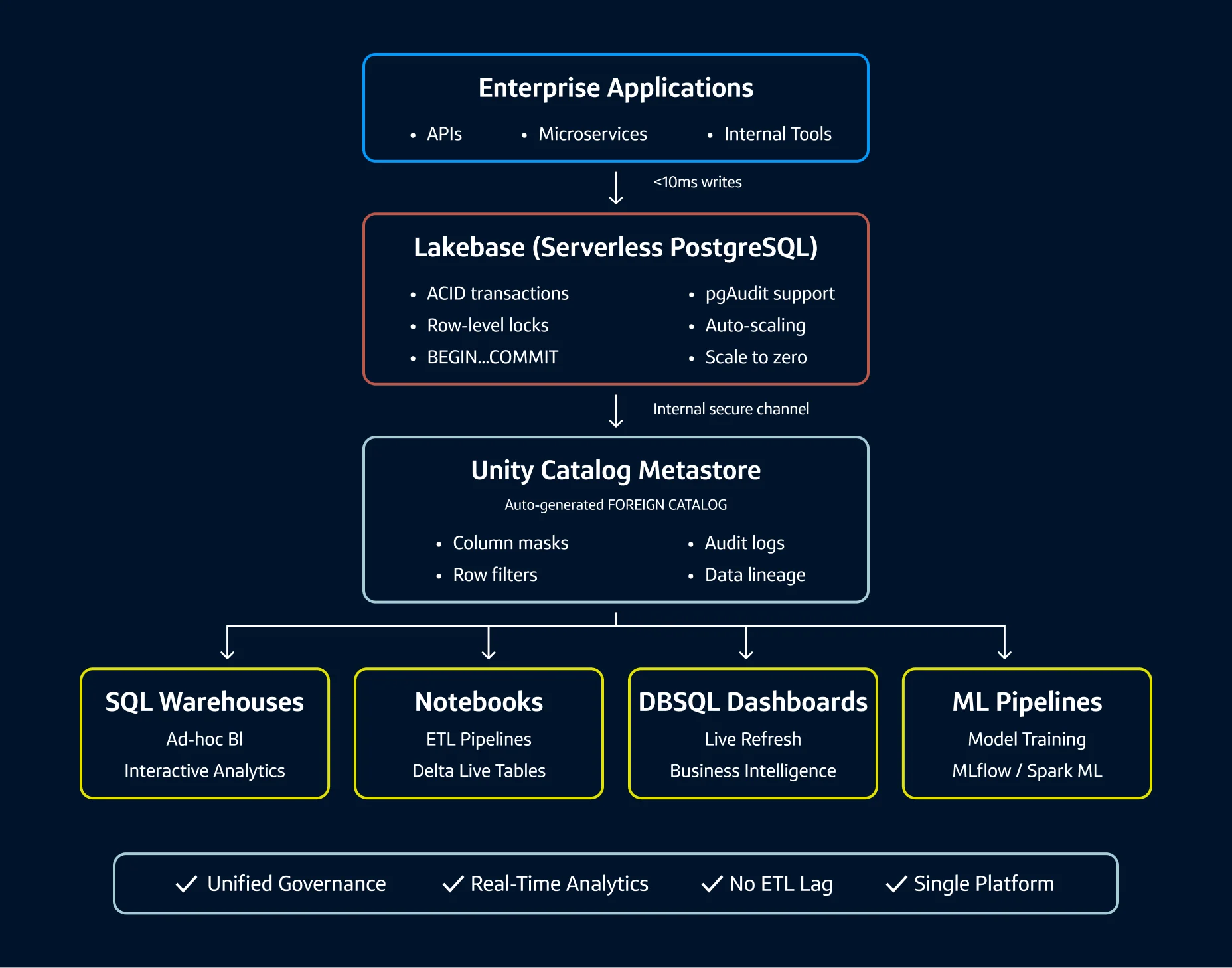
Lakebase Postgres captures live data that is instantly made available through a secure internal channel to the Unity Catalog Metastore. This eliminates the need for complex, manual ETL pipelines, as the transactional records are automatically registered. The exact same data is then also immediately ready for BI analytics, ETL pipelines and ML training, all under a single governance framework.
Real-world AI use cases
The traditional separation of transactional and analytical systems creates fundamental barriers. This is especially true when building AI systems, as seen in the examples below.
Example 1: Credit card fraud detection
ML models require both current transactional data and historical aggregates. Lakebase enables this pattern natively. Let’s take a look at how the split-path architecture can work in a credit card fraud detection system.
When building a fraud prevention system, you want to score every credit card transaction for fraud risk in real-time by combining current transaction details with the cardholder’s historical spending patterns. This way, you can approve legitimate purchases within 50ms while blocking suspicious transactions before they complete, minimizing fraud losses and false declines. In order to do this, you need to be able to run queries against both kinds of registered databases simultaneously.
Transactional features (OLTP: Lakebase):
Current transaction amount, merchant, location
Time since last transaction
Current account balance
Active card status (locked/unlocked)
Analytical features (OLAP: Unity Catalog):
Average transaction amount over the last 30/90 days
Merchant category frequency patterns
Geolocations velocity (distance between transactions)
Historical fraud rate for merchant type
Example implementation
-- Single query joins live OLTP with historical OLAP
SELECT
t.transaction_id,
t.amount,
t.merchant_id,
t.card_status, -- OLTP: current state
h.avg_30d_amount, -- OLAP: 30-day average
h.merchant_category_frequency, -- OLAP: behavioral pattern
h.historical_fraud_rate -- OLAP: risk score
FROM lakebase_cat.public.transactions t
JOIN analytics_cat.features.customer_history h
ON t.customer_id = h.customer_id
WHERE t.transaction_id = ?Result: Sub-50ms feature retrieval for real-time inference, combining separate feature store infrastructure as needed.
Example 2: Autonomous inventory optimization agent
Agentic AI systems need to both read operational state and write actions back atomically. Lakebase provides ACID transactions for agent actions while enabling analytical context. Here's an example of an AI agent that can monitor inventory levels, predict demand and automatically creates purchase orders:
-- Agent reads current inventory + demand forecast
BEGIN;
-- Step 1: Check current state (OLTP)
SELECT product_id, current_stock, reorder_point
FROM lakebase_cat.public.inventory
WHERE current_stock < reorder_point
FOR UPDATE; -- Lock rows to prevent race conditions
-- Step 2: Query demand forecast (OLAP)
SELECT product_id, predicted_demand_7d
FROM analytics_cat.forecasts.demand_predictions
WHERE forecast_date = CURRENT_DATE;
-- Step 3: Agent decides and writes purchase order (OLTP)
INSERT INTO lakebase_cat.public.purchase_orders
(product_id, quantity, supplier_id, created_by, status)
VALUES
(12345, 500, 'SUP-001', 'ai-agent-v2', 'pending');
-- Step 4: Update inventory reservation (OLTP)
UPDATE lakebase_cat.public.inventory
SET reserved_stock = reserved_stock + 500
WHERE product_id = 12345;
-- Step 5: Log agent action for monitoring (OLTP)
INSERT INTO lakebase_cat.public.agent_audit_log
(agent_id, action_type, decision_confidence, metadata)
VALUES
('ai-agent-v2', 'create_purchase_order', 0.94,
'{"product": 12345, "reasoning": "demand_spike_detected"}');
COMMIT;Why ACID matters: The entire sequence (read inventory → check forecast → create order → update reservation → log) must succeed or fail atomically. Lakebase ensures no partial updates, no orphaned orders and no lost audit trails.
Example 3: Customer support AI assistant
RAG systems need to combine vector similarity search with structured data lookups. Lakebase enables a hybrid pattern, like this one:
-- Step 1: Store customer inquiry in OLTP
INSERT INTO lakebase_cat.public.support_tickets
(ticket_id, customer_id, inquiry_text, status, created_at)
VALUES (?, ?, 'My credit card was declined', 'open', CURRENT_TIMESTAMP);
-- Step 2: Retrieve customer context (OLTP + OLAP)
WITH customer_context AS (
SELECT
c.customer_id,
c.account_status, -- OLTP: current state
c.current_balance, -- OLTP: live balance
h.recent_transactions, -- OLAP: transaction history
h.past_support_issues -- OLAP: issue patterns
FROM lakebase_cat.public.customers c
JOIN analytics_cat.features.customer_360 h
ON c.customer_id = h.customer_id
WHERE c.customer_id = ?
)
-- Step 3: Vector search finds similar resolved tickets (OLAP)
-- Step 4: LLM generates response with full context
-- Step 5: Store AI-generated response in OLTP
UPDATE lakebase_cat.public.support_tickets
SET
ai_response = ?,
response_confidence = ?,
status = 'ai_resolved'
WHERE ticket_id = ?;Result: A single transaction ensures inquiry, context retrieval, AI response and status update are atomic. Unity Catalog governance applies to both customer data and AI-generated responses.
Business impact
By bringing OLTP capabilities into the lakehouse Lakebase is enabling teams to enjoy the following benefits:
Unified governance
Single OAuth flow authenticates access to both OLTP and OLAP
Unity Catalog policies (table, column, row filters, masks) apply uniformly
One audit trail instead of reconciling multiple systems
Operational efficiency
Cut down on nightly ETL jobs and data duplication
Reduce infrastructure footprint and associated operational overhead
Auto-scaling eliminates capacity planning guesswork
Cost optimization
Pay only for active compute during business hours
Scale-to-zero during off-peak periods
Retire dedicated OLTP infrastructure and associated licensing costs
Developer velocity
Application teams get standard PostgreSQL APIs
Analytics teams access live data through familiar interfaces
No impedance mismatch between transactional and analytical development
How to get started
Follow these three steps to get up and running on Databricks Lakebase Postgres:
1. Create a Lakebase instance
Compute → OLTP Database → Create Database Instance
- Name: customer_db
- Region: (match your workspace)
- Click Create (~10 seconds)2. Register in Unity Catalog
Instance card → Catalogs → Create managed database catalog
- Catalog name: customer_cat
- Click Create3. Immediate use
CREATE TABLE customer_cat.public.accounts (
account_id BIGINT PRIMARY KEY,
customer_id BIGINT NOT NULL,
balance NUMERIC(15,2),
last_modified TIMESTAMP DEFAULT CURRENT_TIMESTAMP
);
INSERT INTO customer_cat.public.accounts VALUES (1, 100, 5000.00, NOW());
-- Same table accessible to SQL Warehouses, notebooks, ML pipelines
SELECT * FROM customer_cat.public.accounts;When to consider alternatives
Lakebase may not be the best fit if you:
Require horizontally-scaled distributed writes beyond vertical PostgreSQL scaling
Have compliance requirements preventing managed database services
Need sub-second replication to geographically distributed regions
For these scenarios, consider pairing Lakebase with Delta Lake's native ACID capabilities or exploring distributed SQL alternatives.
Conclusion
The traditional OLTP/OLAP is a source of operational complexity, governance gaps, and delayed insights. Databricks Lakebase breaks down this divide by bringing serverless Postgres directly into the lakehouse. You get millisecond transactional performance with full ACID guarantees alongside elastic analytics and ML, all governed by a single identity and access framework and with zero added infrastructure to manage.
The traditional separation of OLTP and OLAP systems creates fundamental barriers. This is particularly true for production AI.
Stale features due to ETL latency
Complex pipelines to synchronize batch and streaming
Train/serve skew from using disparate data sources
Missing transactional integrity for actions taken by AI agents
Fragmented governance across operational, analytics, and ML systems
Lakebase and, more broadly, Unity Catalog eliminate these barriers by creating a unified platform where:
Real-time operational state and historical analytics coexist
Features are computed on-demand with sub-100ms latency
Training and inference use identical data sources
AI agents execute multi-step workflows with ACID guarantees
Unity Catalog enforces consistent governance across the entire AI lifecycle
For enterprise data teams juggling real-time operational systems and deep analytical workloads, Lakebase represents what the lakehouse has always promised: one platform, one governance model and zero trade-offs between transactions and analytics.
Sachin Seth
Technical Writer - Product Marketing, Capital One Software
Sachin Seth is a data platform architect and analytics product builder known for his deep work benchmarking Databricks & Snowflake compute and delivering high-performance data applications at scale. He develops full-stack analytics solutions—ranging from billion-point time-series engines to portfolio optimization apps and real-time financial dashboards—blending Databricks, Snowflake, Rust, Arrow and modern web technologies. He writes to bring clarity, measurement and engineering rigor to the rapidly evolving world of Databricks & Snowflake and modern data platforms.
Footnotes
DISCLOSURE STATEMENT: © 2026 Capital One. Opinions are those of the individual author. Unless noted otherwise in this post, Capital One is not affiliated with, nor endorsed by, any of the companies mentioned. All trademarks and other intellectual property used or displayed are property of their respective owners.