
JUNE 22, 2026 - 6 MIN READ
Smarter Snowflake optimization with Slingshot's contextual AI
- Cloud Cost Management (FinOps)
- Data Management for AI
- Slingshot

Jen HuangManager, Product Management, Capital One Software
As your data landscape continues to grow in scale and complexity, isolated point solutions are not enough to catch inefficiencies from quietly compounding across queries, tables and pipelines. At enterprise scale, tracking these hidden issues manually is an impossible task for any single team.
We ran into this exact challenge at Capital One, so we built Slingshot to manage, govern and optimize our own Snowflake environments (opens in new tab) across tens of petabytes of data. What began as a powerful internal tool has since evolved into a commercial software platform that helps other data-intensive companies achieve granular control, efficiency and visibility over their Snowflake budget and pipeline performance.
In this post, we walk through Slingshot's upcoming AI-powered capabilities: query and table optimization and duplicate pipeline detection. We also cover some other recent developments, including query performance analytics, interactive cost exploration and data-driven before/after analysis for warehouse changes. Together, these features enable enterprises to optimize the entire system.
Enterprise data environments are too complex to optimize manually
Enterprise Snowflake environments generate staggering query volumes. We see this firsthand at Capital One, where thousands of global users run millions of queries a month across petabytes of data. At this scale, manual review is simply impossible.
But volume is not the only challenge. At any scale, small inefficiencies can compound rapidly. For example, a single poorly configured table silently degrades the performance of every downstream query that touches it. Another example is data and tool sprawl that creates blind spots resulting in different groups unknowingly creating duplicative pipelines.
Common questions we hear from customers include:
How do I spot inefficiencies early, before the alarm is raised?
When I make a change, how do I validate that it actually improved things?
Queries don’t run in isolation. Are my tables configured optimally for those queries?
Are multiple teams building and running the same pipelines without knowing it?
How do I know which queries are costing the most and what can I do about them?
Slingshot's newest capabilities in development are built to answer these exact questions.
A system-wide approach: Understand, detect, resolve, validate
Traditional optimization tools tend to operate on surface-level signals. Slingshot takes a different approach by ingesting a multi-dimensional picture of your environment before making any recommendations. It looks at SQL queries to understand intent, query execution history to spot performance bottlenecks, table DDLs to review data structures and access history to map usage patterns and dependencies.
This results in optimizations that are highly contextualized across every step of the data lifecycle:
Understand what is running, what has failed and what it costs.
Detect inefficiencies and opportunities for optimization across queries, tables and pipelines.
Resolve issues with AI-powered, production-validated recommendations.
Validate that changes actually worked by measuring their impact across key performance indicators
Contextual Query Optimization: Optimize inefficient code with AI recommendations that close the loop
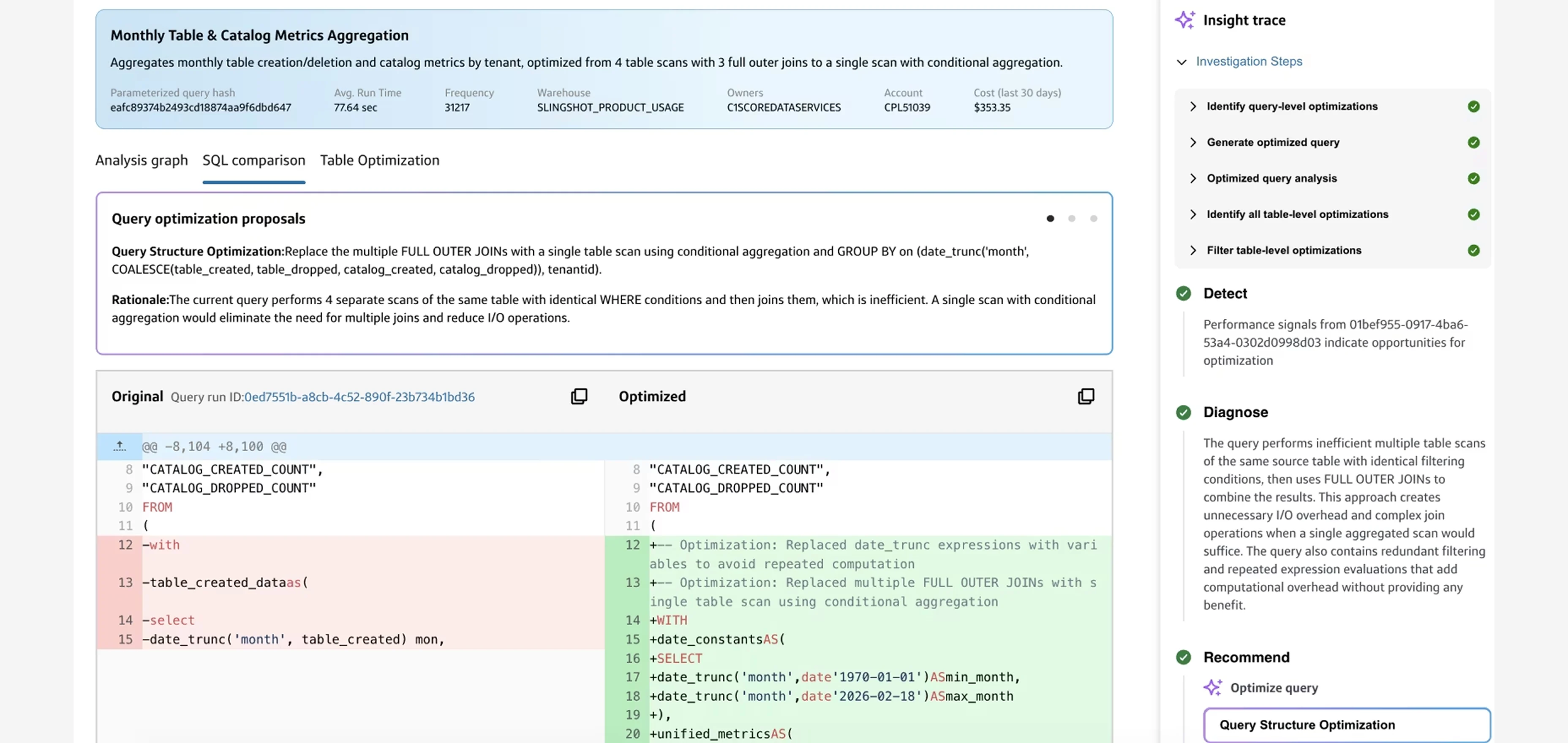
Slingshot already automatically identifies the top queries by cost, runtime and execution frequency. To build on this visibility, Slingshot will generate AI-powered optimization recommendations for each query, such as restructuring WHERE clauses to filter results earlier, eliminating unnecessary SELECT * patterns, replacing inefficient nested queries and changing join types to reduce data movement.
What will set Slingshot apart is its ability to ensure an optimized query does not break anything downstream before recommending it to the user. Every query recommendation passes through two checks to ensure that (1) the rewritten SQL is fully executable against the Snowflake dialect and (2) the outputs match the original query results. The entire analysis is performed using static architectural parsing, so Slingshot never executes queries against real customer data.
The SQL recommendations include clear steps forward alongside projected cost savings and runtime improvements. They also highlight the differences between the original and optimized code, so both the platform admin who discovers the opportunity and the data engineer who implements it can see the full picture before changing a single line of code.
Contextual Table Optimization: Fix the infrastructure, not just the query
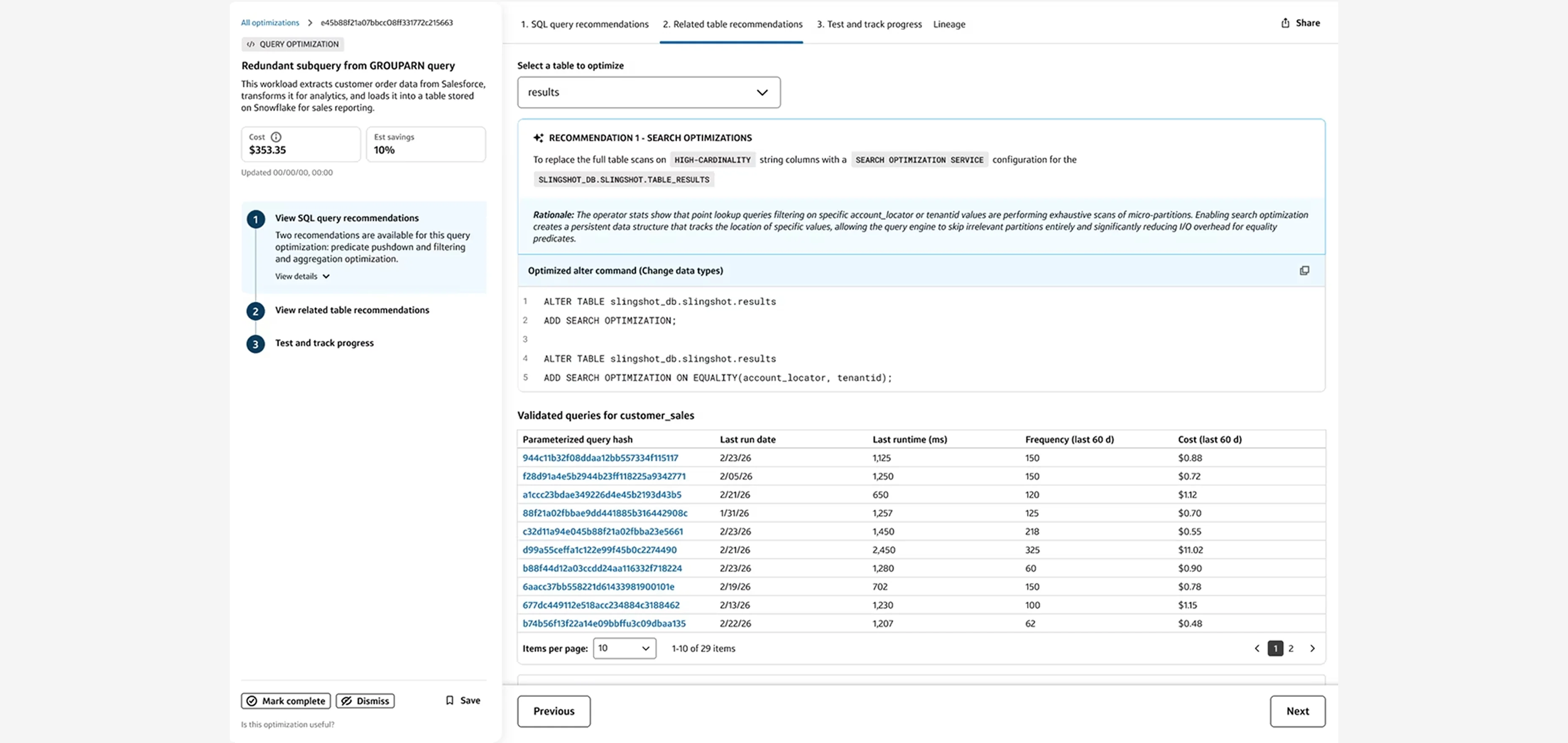
Query inefficiency often does not stem from the code itself. Poorly configured tables with wrong data types, unindexed high-cardinality columns and sub-optimal physical layouts are silent cost multipliers that degrade every query touching them. Even well-managed tables are often built for their first use case, without accounting for the workloads that evolve around them later.
To address this, Slingshot will analyze both the queries and tables they are using to surface underlying issues and ways to improve them, including:
Auto-clustering to reduce partitions scanned across recurring workloads.
Search optimization to accelerate point lookups.
View materialization to reduce compute costs for commonly-used views.
Data type corrections to cut scan costs by replacing expensive VARIANT columns with native numeric types.
Notably, before providing a recommendation, Slingshot will validate that every proposed table change will not degrade the top queries that are running against that table. This includes queries run by entirely different teams, so that one team's improvements don’t come at the cost of another team's.
Duplicate Pipeline Detection: Surface redundancy across the organization
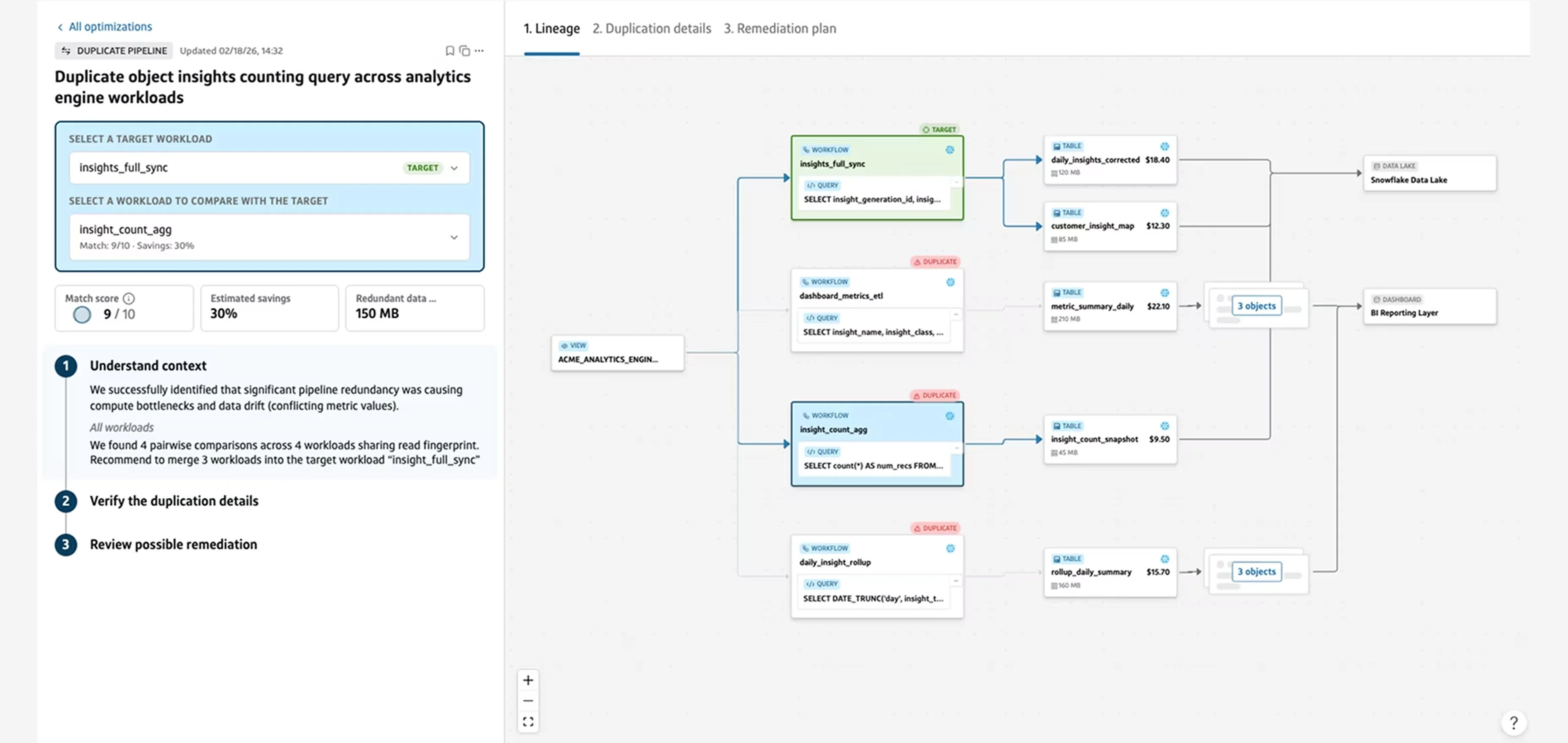
Large enterprises have entire pipelines that are unknowingly redundant. Analysts build near-identical ELT pipelines, with slightly different filters. Business users create ad-hoc data processes that bypass governed pipelines entirely. The result is wasted compute and storage and multiple versions of the truth.
Slingshot's AI-powered duplicate pipeline detection will identify these redundancies by analyzing common patterns of data usage to find potential overlaps. It evaluates functional equivalence at a scale no human team could match, comparing:
Column names and formats
Result distributions
Update frequency
Access patterns across similar workloads
When a potential match is found, a recommendation for consolidation with a confidence score and projected cost impact is displayed for each potential duplicative pair. In addition, a lineage view is displayed for each pair, which surfaces everything you need to decide whether consolidation makes sense: source tables, workload paths, individual queries, ownership and query text.
Query Details: Track every query's performance history and trends over time
Because Snowflake's native UI does not provide an easy way to track and analyze a query's behavior across runs over time, understanding historical performance trends can be difficult. Slingshot solves this by retaining full query history from the moment a customer onboards and surfacing it through a dedicated Query Details page built around the Parameterized Query Hash (opens in new tab), a unique identifier that groups all executions of the same logical query regardless of the literal parameter values used.
With this view, data teams can track the health over time of key metrics such as duration, bytes scanned, spillage and queued time, broken down at the average, P50 and P90 levels. This level of granularity allows users to identify a single spike in P90 that the average may mask, which is exactly the kind of signal that precedes an outage or a budget blowout. Entry points throughout the platform, from the costliest queries widget to optimization red-flag areas for poor pruning and long-running failures, link directly to the relevant Query Details page so that engineers can move from an alert into a full investigation in one click.
Data Explorer: Investigate root causes quickly with interactive cost analysis
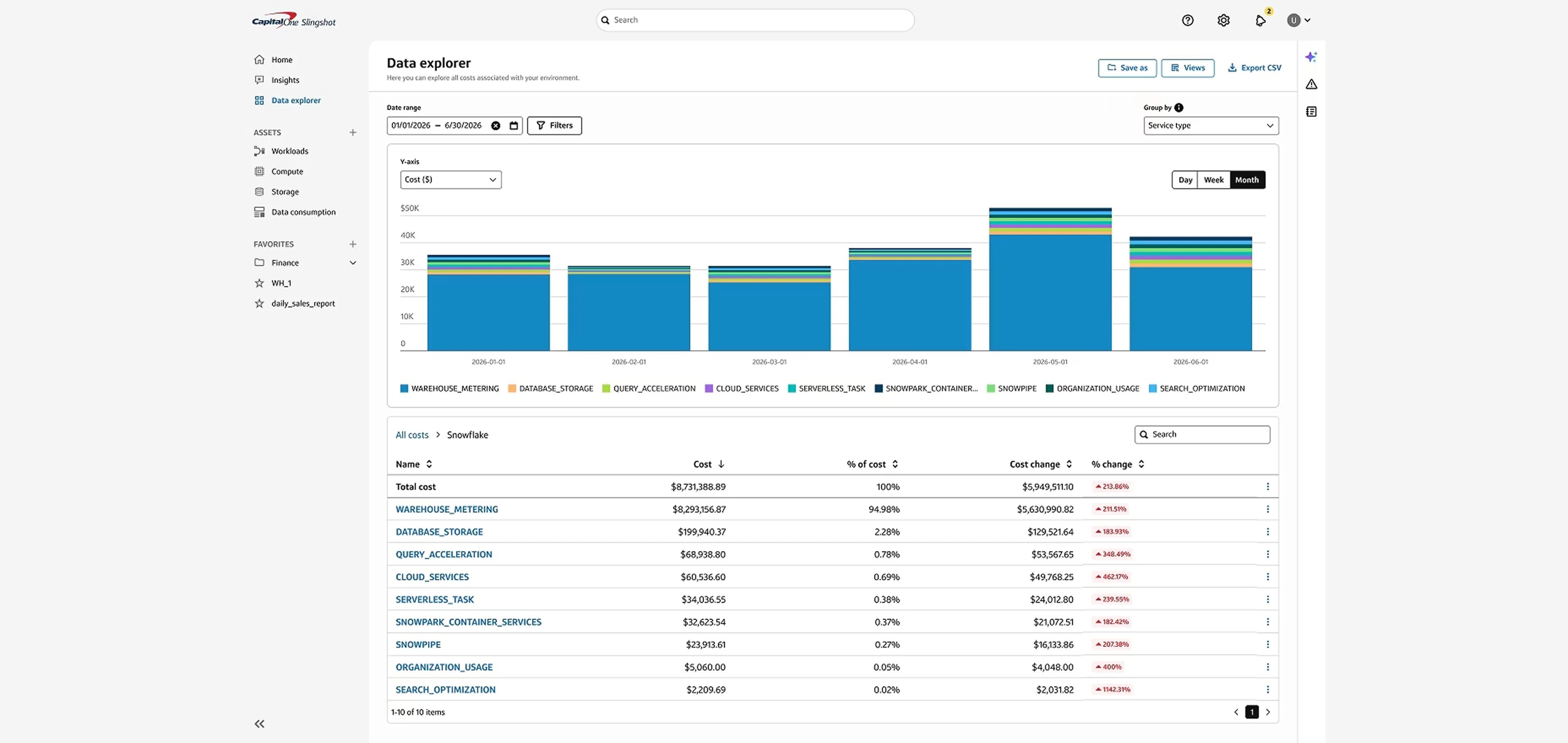
Slingshot's Data Explorer is an interactive, drill-down analytics interface built for the way data teams actually investigate cost issues. Users will be able to slice and dice Snowflake spend interactively across accounts, users, parameterized query hashes, Slingshot tags and service types, with synchronized filtering across all charts and tables.
Drill-downs lead to rich object detail pages for individual warehouses, databases and queries directly from table rows, eliminating the gap between cost visibility and the actions that change cost. Long historical retention and CSV export ensure cost data is available for the long-term trend analysis that budget cycles actually require. Finally, full access control integration means every user sees exactly the cost data relevant to their scope.
Warehouse Impact Analysis: Measure configuration changes with before/after validation
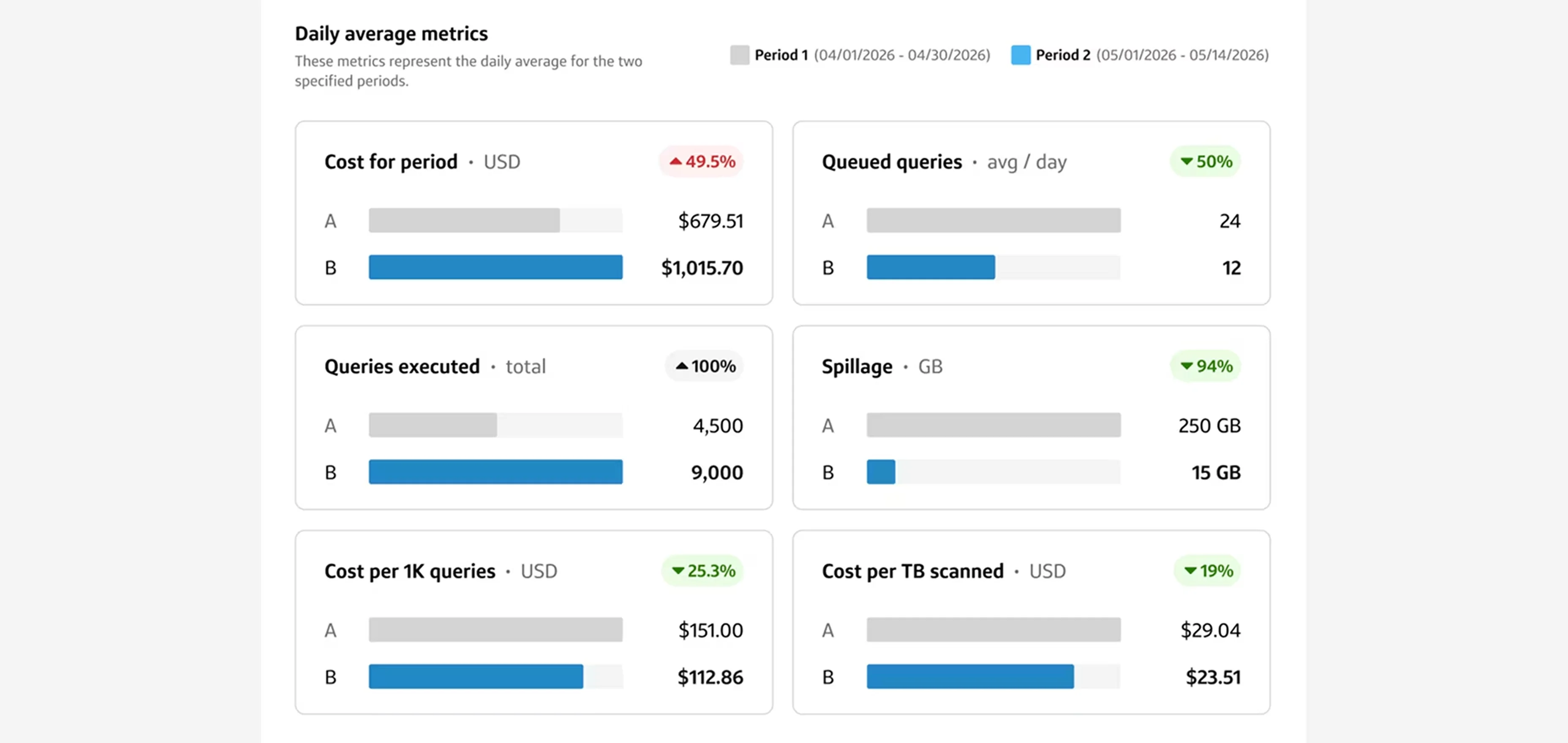
Applying a recommendation or resizing a warehouse is only half the job - knowing whether or not it worked is the other half. Slingshot's Warehouse Impact Analysis removes the guesswork by letting teams isolate and compare any two time periods side by side, from 1 day up to 6 months, anchored to a specific warehouse change or a custom date range. Comparisons can be launched via a dedicated “Compare periods” tab on the warehouse details page, or by clicking any specific change event in your warehouse history to auto-populate the timelines.
To track if you’re running more efficiently and not just fewer total jobs, key metrics like cost per 1,000 queries and cost per TB scanned all update together in a unified view. These work alongside key health metrics such as daily average cost and average query runtimes to give a complete picture of warehouse health. Finally, to protƒ1ect data SLAs, a dedicated query table surfaces the top 50 longest-running queries in each period, so teams can immediately see whether a change improved performance, shifted load elsewhere or introduced a regression before the impact shows up in a budget report.
Conclusion
Slingshot's new AI features in development will help teams expand the focus of optimization from individual resources to the full system. Instead of wasting hours manually rewriting inefficient SQL, users can now use Contextual Query and Table Optimization to make deep, pre-validated adjustments before they ever reach a data engineer. To solve the enterprise challenge of organizational blind spots, Duplicate Pipelines can surface and eliminate organizational-level redundancy that siloed teams couldn’t even find on their own. Finally, to track whether an infrastructure change actually helped or hurt, Warehouse Impact Analysis ensures every optimization decision is backed by historical data and every change is measurable.
This changes the daily reality of managing a massive data cloud environment. You can detect and act on inefficiencies across queries, tables and pipelines at a scale no team could manage manually. Because Slingshot automatically verifies that the rewritten optimized queries run correctly and match your original data outputs, this gives your team a verified starting point to test recommendations in a lower environment before deploying them to production, where you can then measure the exact impact of every change.
Ultimately, system-wide efficiency is about more than lowering tomorrow's bill. When infrastructure tuning changes from a stressful firefighting exercise into a predictable science, you can scale your data footprint without sacrificing cost or engineering time. Slingshot provides the framework to make continuous, safe adjustments a seamless part of your data strategy, giving you the control to run a lean, high-performing system at scale.
Interested in learning more? Book time with the team here.
This post may contain forward-looking statements about Capital One Software’s upcoming product features. Some features described in this post are in development and not yet generally available. Development, release and timing of features are at Capital One Software’s sole discretion and may change without notice. Feature capability and availability are speculative and should not be relied upon for purchasing decisions. Contact Capital One Software for details.
Jen Huang
Manager - Product Management, Capital One Software
Jen Huang is a product manager for Capital One Slingshot, where she works on object-level observability and warehouse recommendations. She is focused on helping data teams understand and optimize their Snowflake environments at scale. Before moving into product management, Jen worked as a strategy consultant at Capital One, where she developed a foundation in enterprise strategy that shapes how she thinks about product decisions at scale.
Footnotes
DISCLOSURE STATEMENT: © 2026 Capital One. Opinions are those of the individual author. Unless noted otherwise in this post, Capital One is not affiliated with, nor endorsed by, any of the companies mentioned. All trademarks and other intellectual property used or displayed are property of their respective owners.