
NOVEMBER 23, 2026 - 5 MIN READ
Optimize Snowflake compute and verify impact with Slingshot
- Cloud Cost Management (FinOps)
- Data Governance
- Data Observability

Alex GuoProduct Marketing Manager, Capital One Software
Managing enterprise Snowflake footprints is a difficult balancing act for platform and data teams. They either spend valuable engineering hours manually tuning clusters, or avoid it more than they should out of fear of breaking someone else’s pipeline. Enterprise teams need clear guardrails, administrative control and trust that any infrastructure change will not disrupt performance.
To address this challenge, Capital One Slingshot now offers a unified set of features, Warehouse Optimizations, paired with built-in Impact Analysis. Together, these features give enterprise teams the control they need to right-size warehouses, migrate eligible workloads to Gen2 instances and measure the impact of every change.
Targeted compute control with Warehouse Optimizations
Finding idle compute spend across hundreds of warehouses takes continuous effort, but platform teams cannot afford to risk breaking critical pipelines. Slingshot's suite of new Warehouse Optimizations features give administrators policy-driven guardrails to safely reduce compute waste while keeping full control over high-priority environments.
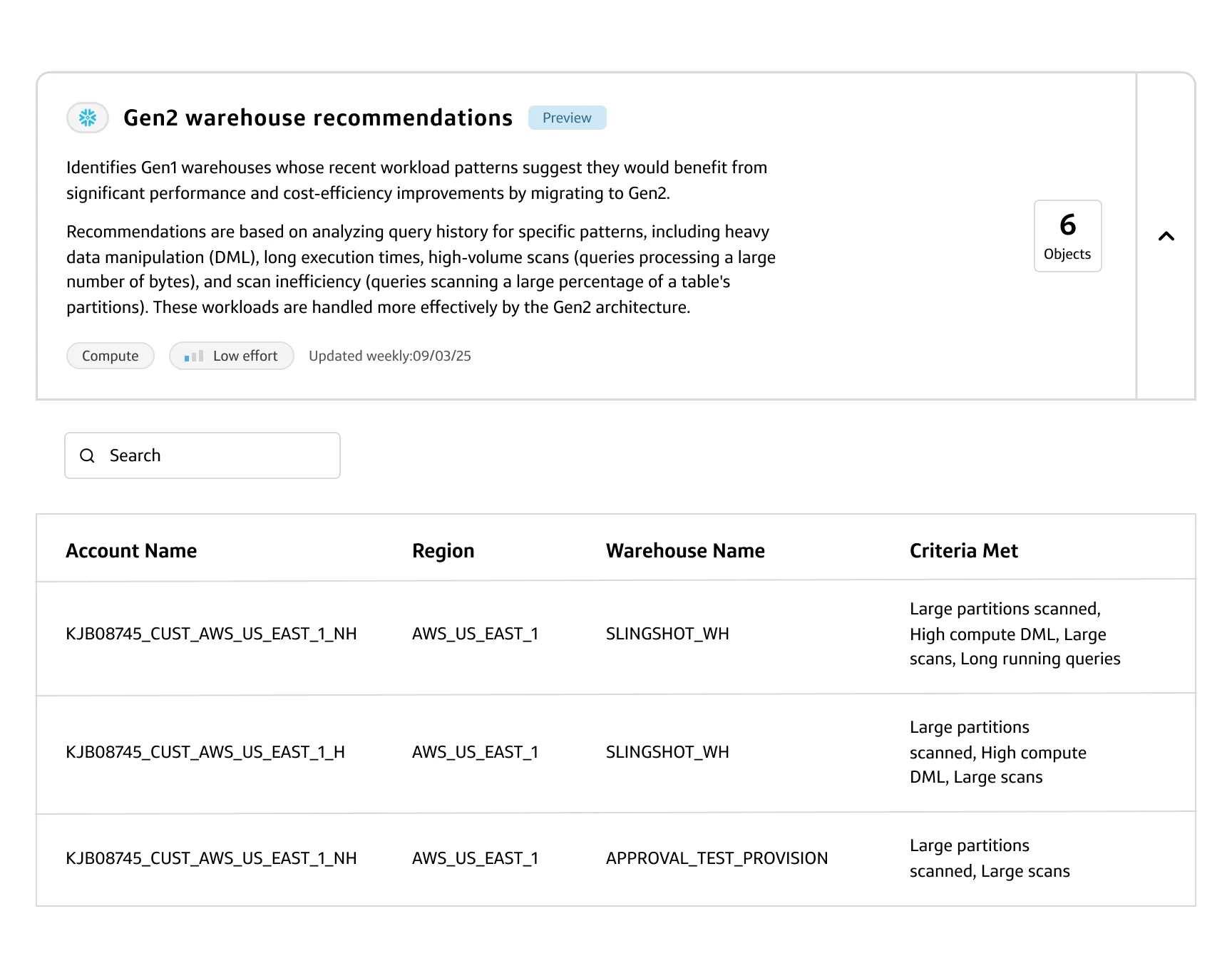
Upgrade to Gen2 compute hardware: While Gen1 warehouses handle routine tasks well, high-intensity processing often requires more power. Slingshot Gen1 to Gen2 Recommendations analyzes query activity weekly to flag Gen1 warehouses handling heavy data updates, large table scans or long-running jobs that would run faster on Gen2 hardware. Proactively identifying and fine-tuning eligible workloads after the migration is complete lets you upgrade instances to improve execution performance and lower compute costs.
Capture savings faster with Weekly Recommendations: Monthly tuning schedules often miss short-term usage shifts and changing workload patterns. Slingshot now analyzes recent workload activity every week to surface timely right-sizing options so you don’t have to wait for a monthly update. Teams can opt-in to these Weekly Recommendations to adjust compute schedules faster and capture cost savings sooner.
Automate non-production tuning with Auto Apply: Manually reviewing schedule changes for dozens of development and lower-environment warehouses takes up valuable engineering time. Auto Apply Recommendations lets Tenant Admins set policy rules to execute recommendations automatically whenever estimated cost savings exceed $0. By automating routine schedule updates across non-production systems, you can capture long-tail compute savings effortlessly without adding manual overhead.
Protect production SLAs with Exclude / Dismiss (currently in Preview): Production workloads with strict SLAs require absolute stability and cannot risk unexpected schedule changes. Slingshot Exclude / Dismiss allows teams to dismiss optimizations that conflict with business requirements or to turn off recommendation generation entirely for high-priority production warehouses with strict SLAs. This keeps your optimization queue clean and ensures team efforts stay focused only on safe, high-impact changes.
With Warehouse Optimizations, you no longer have to choose between manual warehouse maintenance and uncontrolled spend. Now you can set clear policy guardrails across your footprint to safely cut waste in low-risk environments while keeping your most critical production workloads stable.
Validate performance improvements with Warehouse Impact Analysis
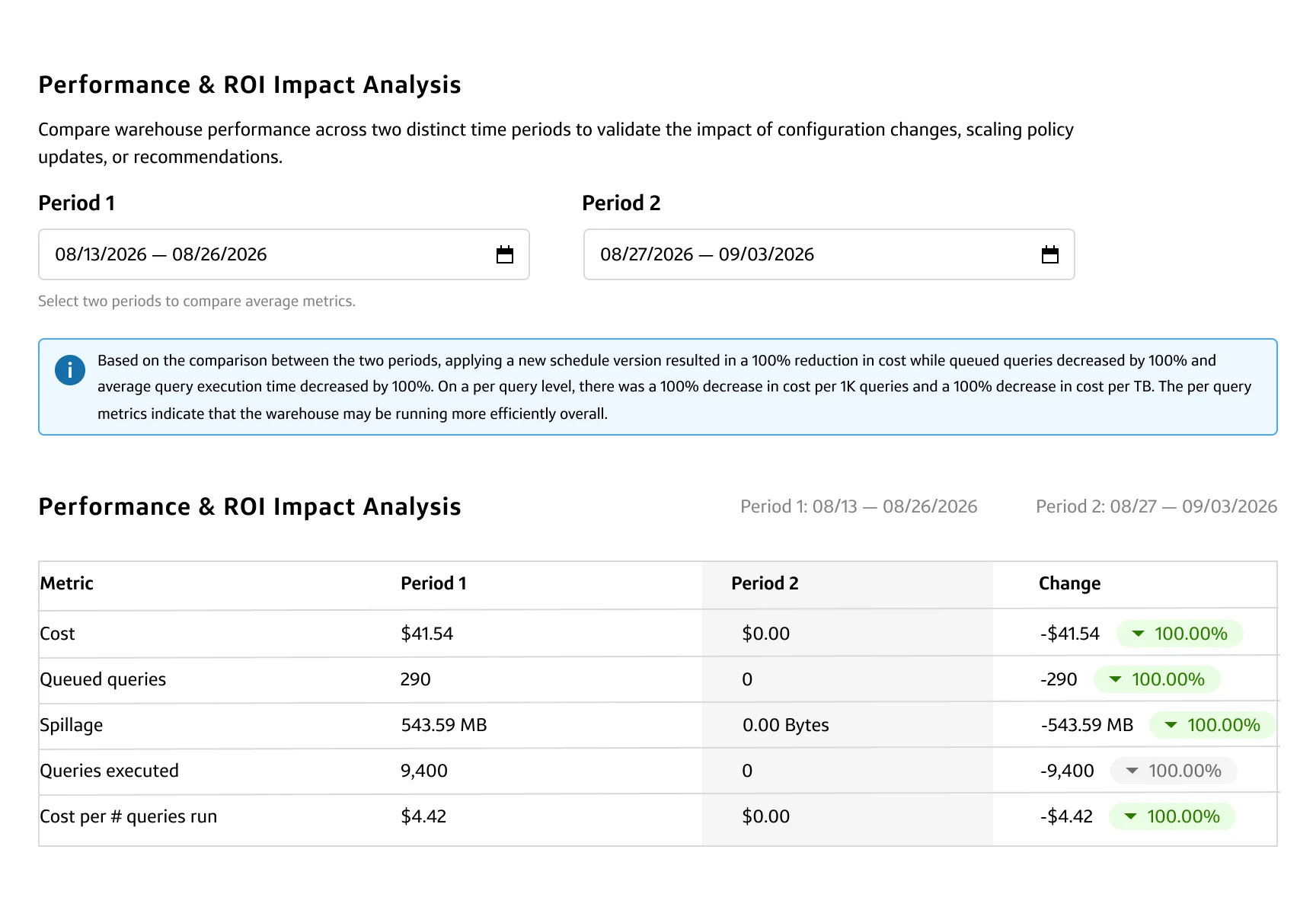
Making an infrastructure change is only half the job. Platform and data engineers still need to prove that a specific tuning decision actually improved efficiency. Slingshot's new Warehouse Impact Analysis feature provides a direct before-and-after comparison for any warehouse change, letting you track performance shifts directly within the warehouse details view.
Compare performance across specific time periods: Evaluate metrics across custom dates or directly before and after a warehouse change to see its true impact on your operations.
Understand efficiency: Track normalized performance indicators, like Cost per 1,000 queries and Cost per TB scanned, so temporary spikes in query volume do not mask true cost or performance savings.
Review automated summaries: Read plain-language summaries detailing percentage changes in total cost, queued query counts, execution runtimes and unit metrics to quickly assess overall warehouse health.
With Warehouse Impact Analysis, you no longer have to guess whether a schedule change or hardware update was successful. Now you can tie back infrastructure updates directly to performance metrics, helping you prove the ROI of changes while protecting workload SLAs.
Conclusion
By pairing customizable optimization guardrails with built-in impact analysis, Slingshot helps you turn enterprise Snowflake cost management into a predictable, repeatable process.
Instead of guessing why spend is rising on a warehouse, platform and data teams can use Slingshot to apply a Gen1 to Gen2 recommendation to boost performance while lowering costs. They can then open the Impact Analysis tab to compare metrics right before and after the update, while tracking indicators like cost per 1,000 queries to prove that unit costs dropped while queue times stayed low. Finally, they can enable Auto Apply across dev environments to eliminate idle spend, using exclusion rules to protect critical production SLAs.
By combining proactive tuning with clear performance verification into an end-to-end workflow, enterprise data teams can lower compute spend confidently while protecting performance across every workload.
Interested in seeing how Warehouse Optimizations and Impact Analysis work across your Snowflake footprint? Book time with the Slingshot team here.
Alex Guo
Product Marketing Manager - Capital One Software
Alex is a Product Marketing Manager at Capital One Software, leading go-to-market initiatives for Slingshot. He focuses on helping enterprise organizations optimize performance and control compute costs as they scale heavy data and AI workloads across Snowflake. Previously, he drove product marketing strategies at Datadog and Attentive.
Footnotes
DISCLOSURE STATEMENT: © 2026 Capital One. Opinions are those of the individual author. Unless noted otherwise in this post, Capital One is not affiliated with, nor endorsed by, any of the companies mentioned. All trademarks and other intellectual property used or displayed are property of their respective owners.