
SEPTEMBER 24, 2026 - 8 MIN READ
Format-preserving encryption vs. tokenization
- Data Governance
- Data Security
- Tokenization

Sachin SethTechnical Writer, Product Marketing, Capital One Software
Key takeaways
Format-preserving encryption (FPE) preserves specified structural properties. With consistent deterministic settings, protected values can also remain matchable across systems.
A tokenization solution can build on FPE, combining cryptography with token construction, field handling, deployment, integrations and operational controls.
Capital One Databolt brings vaultless tokenization, customer-environment processing and centralized management together to support enterprise data protection.
Sensitive data rarely stays in one system. A customer identifier, for example, can appear in transaction tables, fraud pipelines, support applications and AI workflows—each using it differently. Some need to connect records belonging to the same customer. Others need to display the original value to an authorized user.
Protecting that identifier means accounting for all those use cases. Its replacement must remain useful even when the original value isn't allowed, and at the same time, permitted users/processes must be able to recover the original values seamlessly. Several requirements flow from that:
Fit existing applications. Meet the field length, character set and validation requirements of the systems using the data.
Preserve useful relationships. Keep matching records connected for joins, deduplication and analysis within the intended scope.
Control recovery. Determine which users and applications can retrieve original values and under what conditions.
Work inside existing workflows. Integrate protection into the pipelines and platforms where data is created, stored and used.
Keep pace with demand. Support growing volumes and concurrent workloads within acceptable processing times.
Make access accountable. Record recovery activity so teams can understand how sensitive values are being used and auditability.
Accommodate change. Manage keys, policies and configurations as applications and access requirements evolve.
Tokenization vs. FPE
FPE and tokenization enter the conversation because both can produce protected values that remain compatible with existing data structures. A card number becomes another valid-looking card number with both. The column type holds and the pipeline can run. That similarity can make them sound interchangeable. It can also make them sound like competing technologies when, in practice, they compose to make the entire system possible.
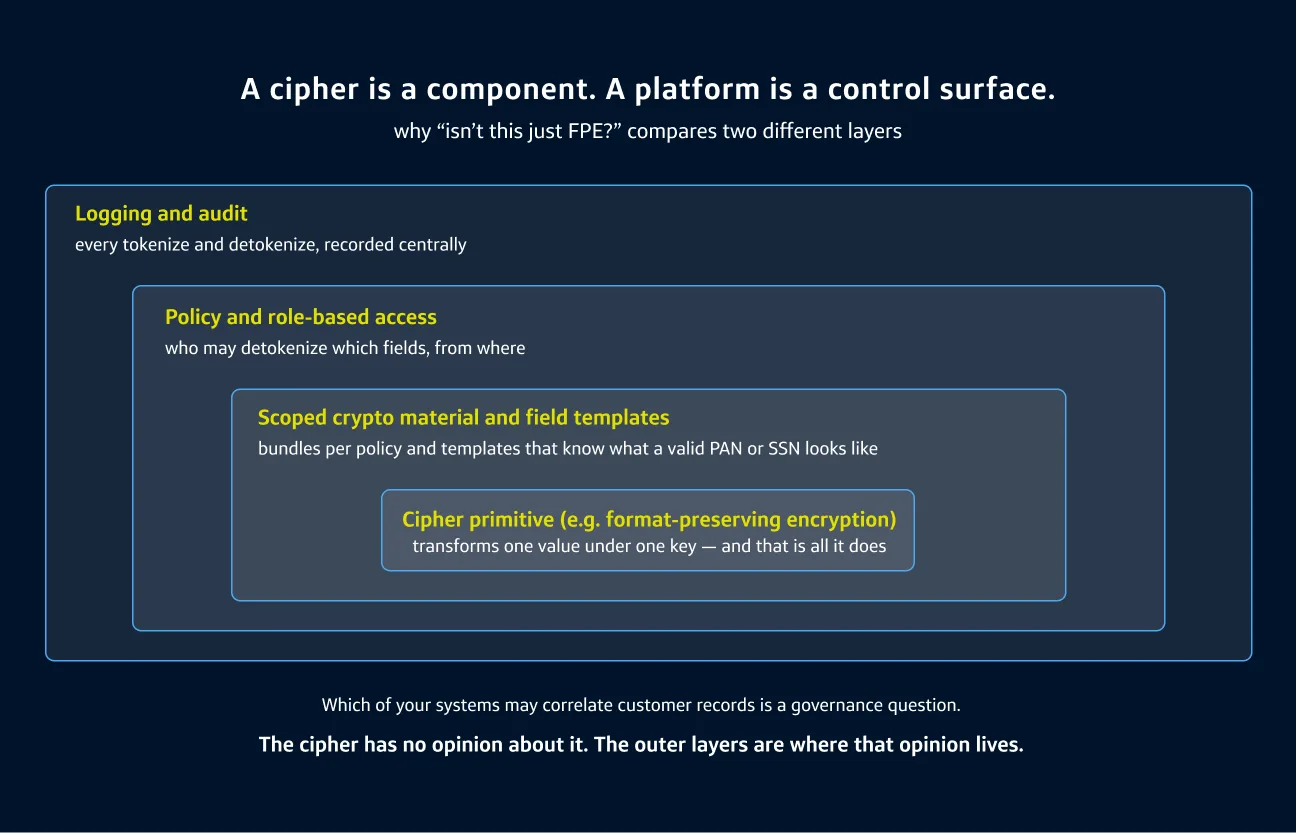
The distinction becomes clearer when we separate the transformation from the system that delivers it:
FPE is a transform, it specifies how a value is encrypted within a defined format.
Tokenization is a process that contains a transform. It describes the use of replacement values and it can use FPE internally.
The connection between FPE and tokenization can also be literal. Some tokenization solutions use a format-preserving cipher as the primitive. A tokenization solution builds on its chosen cryptographic construction adding value with additional capabilities, such as field handling, recovery material management, deployment processing, integrations, access controls and audit logs. Those capabilities determine how the protection works in production.
Think of a processor and the computer it powers. The processor performs essential operations while memory, storage, networking and software turn those capabilities into a working system. Similarly, a tokenization solution combines its cryptographic transformation with the processing, interfaces and operating capabilities needed to protect sensitive data across the enterprise.
Databolt provides a concrete example of how these ideas come together in a product that solves every operational requirement listed above. Its vaultless tokenization architecture, integrations, centralized policies and fine-grained access controls connect the protection of sensitive values to the broader requirements of an enterprise.
The usability of the protected data
The usability of protected data is a key concern when it comes to choosing a protection technique. At the highest level, data usability relies on two aspects:
Determinism: The same value produces the same surrogate. This is what holds identity together across systems that never exchange plaintext.
Format preservation: A protected value maintains the same structure. This is what ensures columns hold and the data keeps flowing through the pipelines.
A protected field can retain its format without retaining a consistent mapping. Different replacements for the same original value may still fit the schema, but applications can no longer join them directly by equality. When protected values must support joins or deduplication, consistent mappings become a requirement.
Determinism also makes repeated values visible as repeated values. In fields with few possible values, those frequencies can help an attacker infer what a replacement represents. The scope of consistency therefore matters.
FPE's tweak binds a ciphertext to a context. A tokenization solution can provide configuration mechanisms for managing the intended scope across applications. Systems that need to join must use compatible settings and input handling; systems that should not share a mapping can use separate scope. Both approaches depend on determinism but only a tokenization solution makes it useful.
Tokenization brings the components together
FPE provides a specified transformation. It’s a keyed, reversible form of encryption, with methods such as FF1 specified by NIST SP 800-38G standardization as its defining strength. The algorithm is public, has been analyzed by the research community, can be implemented interoperably by different vendors and can be validated against the specification.
FPE is a sharp tool with a spec sheet that ends at the transform. Everything else a production deployment needs sits out of scope and building it is on the implementing team, including:
Key storage and rotation
Validating what counts as a well-formed value
Deciding who may decrypt and from where
Logging that a reversal happened
A tokenization solution combines token generation and recovery with the capabilities needed to operate them. Its cryptographic construction may use FPE or another transformation with additional processing depending on the design. The surrounding product must provide:
Field handling and configuration for supported input and output formats.
Token-generation stages such as encoding, shuffling, metadata handling or validation, where the construction uses them.
Management of cryptographic material and configurations that determine token mappings.
Deployment options and integrations that place processing within application and data-platform workflows.
Fine-grained access controls and monitoring of tokenization and recovery activity.
Automated audit trails of every request and operation for auditability and compliance.
For an FPE implementation, evaluate the method's suitability for the data and infrastructure around it. For a tokenization product, evaluate how the construction and product capabilities work together to solve the operational requirements of the enterprise.
Key differences of FPE vs. tokenization
Where recovery sits
An FPE library provides a decryption function. The application or service exposing it must authenticate callers, enforce access rules and record the relevant activity. A tokenization solution supplies supported interfaces and controls for performing tokenization and recovery, shifting the burden from the implementing party onto the tokenization vendor.
The real distinction is how those capabilities are delivered. Both an encryption service and a vaultless tokenization solution must protect the material that enables recovery. If sufficient secret material is extracted and transformation can be run independently, service-level policies may no longer govern that recovery.
Where the keys live
An FPE deployment inherits its security from whatever key management the deploying team builds: storage, rotation, scoping across environments, revocation. Those are solvable problems with mature tooling and solving them well is real, ongoing work.
A tokenization solution handles this out of the box: packaging cryptographic primitives, scoping policies and managing custody directly within the platform. It presents a classic build-vs-buy trade-off: in-house control and self-reliance on one side, with an integrated, fully managed solution on the other.
What must remain secure and available
FPE deployments fail at the edges that the standard does not cover: A domain too small for the security margin, tweaks reused where they should vary or varied where a join needed them constant and key material that sprawls because every consuming system needs a copy.
Tokenization deployments fail differently. The solution becomes a dependency with its own availability story, which is why we built Databolt for the high-availability and low-latency an enterprise requires. In addition, tokenization concentrates custody into the scoped material and an over-broad policy or over-permissioned role can spend the advantage the system was meant to provide.
Example: Payment card protection
Now, let’s run one concrete requirement through both options. A payments estate needs card_number protected with four properties:
Format needs to survive, because pipelines and schemas depend on it.
Joins need to survive across the CRM and the billing systems.
Analysts should never see plaintext.
Fraud operations can recover the value, case by case, with a record of each recovery.
An FPE library supplies the reversible transformation and, under consistent parameters, the equality property needed for joins. The implementation must still handle any additional card-format requirements and ensure that participating systems use compatible settings. That covers the first two properties. The last two are homework for the deploying team.
The work includes authenticated recovery paths, role-based access, logging, deployment and cryptographic lifecycle management. These components must work together so analysts can use protected records, while authorized fraud operation users recover values when needed. By building this the team is no longer deploying a cipher, it’s building a tokenization solution around one.
Choosing between tokenization and FPE
The choice between tokenization vs. FPE follows the shape of the work. FPE fits when the need is a standardized primitive inside something being built: a data platform team embedding protection in its own pipeline framework, a product that must interoperate with other FPE implementations, an environment where the surrounding controls already exist and only the transform is missing.
A tokenization solution comes in when the need is for governed protection across an estate, specifically when data spans multiple fields and systems and there is no appetite to build a custom control surface in-house. When your sensitive data spans systems and fields, reversal must be controlled, policy-driven and logged.
As stated before, these approaches are not mutually exclusive. A tokenization solution may use FPE as the primitive. The comparison table below is based on the complete implementations available for FPE and tokenization and how well they support the data, applications, controls and operating requirements of the enterprise.
| Empty Cell | Format-preserving encryption | Tokenization solution |
|---|---|---|
What it is | A cipher mode: FF1 or FF3-1, standardized in NIST SP 800-38G | A product combining token generation and recovery with deployment, integrations, access controls and operational management |
What's standardized | Methods such as FF1 have a published algo specification | Security guidance exists; the token construction and product architecture need the evaluation |
What you evaluate | Algorithm suitability, parameters and the implementation around it | Token construction, format support, deployment, integrations , lifecycle management and access controls |
Recovery controls | Anyone holding the key, offline | A caller the policy layer authorizes, with the operation logged |
Key handling | Yours to design: storage, rotation, scoping | Managed through the product’s supported recovery interfaces and access model |
Best fit | A standardized primitive inside something you're building; interoperability with other implementations | Coordinated protection across applications and platforms using an integrated product |
Conclusion
Format preserving encryption specifies a transformation. A tokenization solution brings a token construction together with the capabilities needed to deploy, integrate and manage protection and operations. Similar-looking outputs can sit within substantially different operating architectures.
The decision of whether to use FPE vs tokenization should follow the workload: which properties must survive protection, where processing must run, who needs recovery and how the system will operate over time. Databolt satisfies these enterprise requirements through vaultless tokenization, customer-environment processing, platform integrations and centralized management.
To see how a tokenization platform handles your own data estate, book time with the Databolt team.
Sachin Seth
Technical Writer - Product Marketing, Capital One Software
Sachin Seth is a data platform architect and analytics product builder known for his deep work benchmarking Databricks & Snowflake compute and delivering high-performance data applications at scale. He develops full-stack analytics solutions—ranging from billion-point time-series engines to portfolio optimization apps and real-time financial dashboards—blending Databricks, Snowflake, Rust, Arrow and modern web technologies. He writes to bring clarity, measurement and engineering rigor to the rapidly evolving world of Databricks & Snowflake and modern data platforms.
Footnotes
DISCLOSURE STATEMENT: © 2026 Capital One. Opinions are those of the individual author. Unless noted otherwise in this post, Capital One is not affiliated with, nor endorsed by, any of the companies mentioned. All trademarks and other intellectual property used or displayed are property of their respective owners.