
NOVEMBER 5, 2026 - 9 MIN READ
Vaulted vs vaultless tokenization: Differences and use cases
- Artificial Intelligence
- Cybersecurity
- Data Architecture
- Data Security
- Tokenization

Sachin SethTechnical Writer, Product Marketing, Capital One Software
Key takeaways
Capital One Databolt is a vaultless tokenization solution that lets compatible workers generate matching tokens without consulting or updating a shared mapping store, making it ideal for distributed analytics and AI workloads.
Vaulted tokenization solutions add a growing repository of sensitive mappings that must be stored, protected, replicated, backed up and recovered.
Vaulted tokenization remains useful when direct management of individual associations is a defining requirement.
Whether masking customer identifiers during warehouse ingestion, synchronizing tokens across regions or executing high-throughput cluster backfills, modern workloads break centralized tokenization solutions. To unleash the full value of your data for AI and analytics, data security must shift into the processing layer wherever that data lives.
Sensitive data protection solutions that use tokenization have two main architectures:
Vaulted tokenization: Solutions in which associations between plaintext and tokens are retained and stored, because recovery depends on looking up the stored mapping. Those associations need to be kept separate from the datasets that use the tokens. This vault is a growing mapping store that needs to be indexed, replicated, protected, backed-up and recovered.
Vaultless tokenization: These solutions use an algorithm to generate tokens and recover original values without storing individual mappings. Databolt is a vaultless solution that enables workers with compatible inputs and tokenization settings to independently generate matching tokens to support distributed analytics and AI workloads.
Both vaulted and vaultless tokenization solutions authenticate the caller, authorize the operation and validate the input. A vaulted solution stores the association between a sensitive value and its token. Vaultless solutions avoid creating a new datastore for compute tokens using a configured transformation, without creating a new datastore for the value-to-token mapping.
On recovery, both must authenticate the caller, authorize the operation, protect the returned plaintext value and record the operation as required for auditability. The architectural difference is whether recovery depends on a retained mapping or an algorithm.
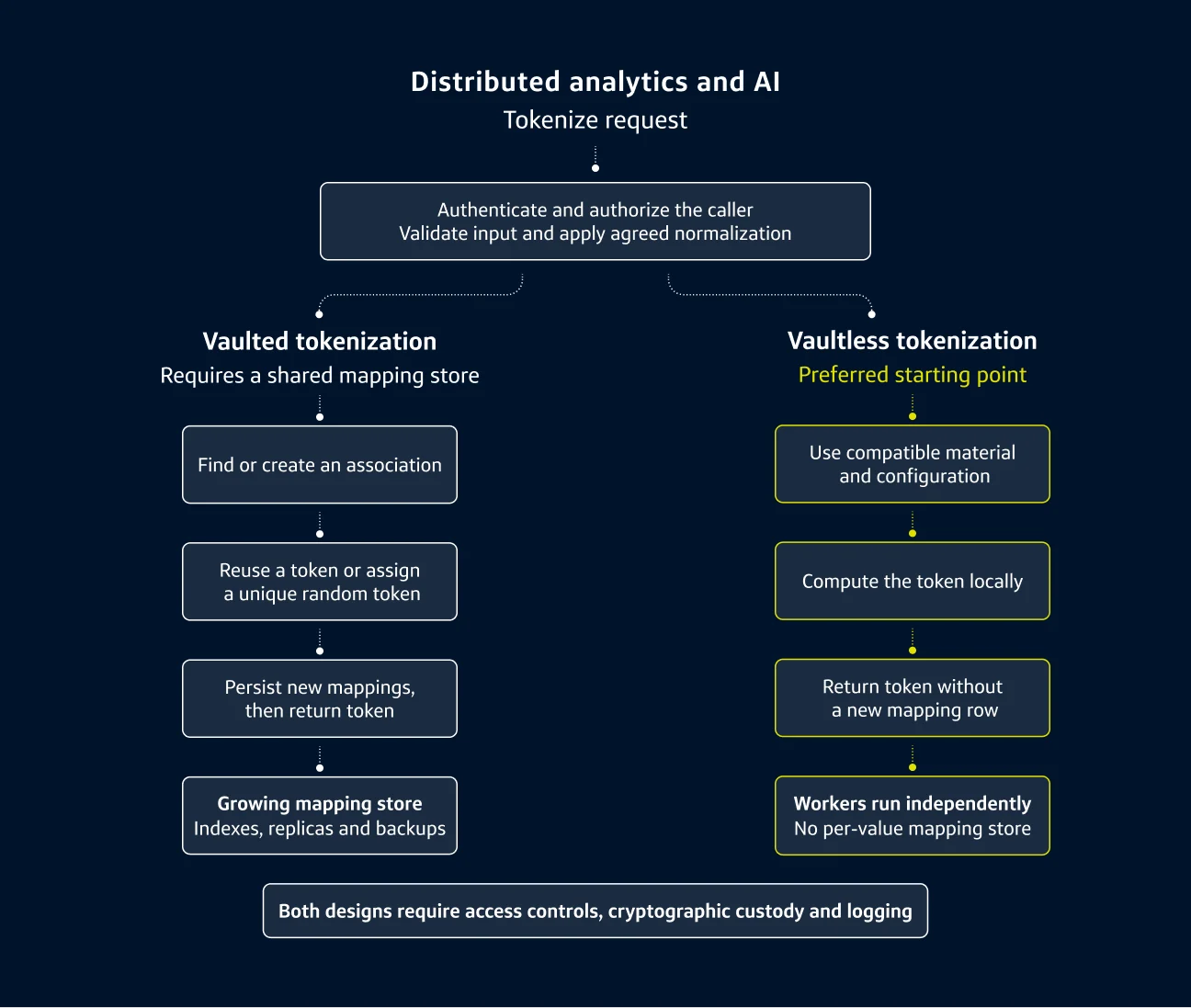
Figure 1: A vault retains value-to-token mappings in a datastore that grows and needs to be protected and maintained. Databolt computes tokens without adding a mapping record for each new value.
Vaults grow alongside your data
The stored associations in a vault create a second body of data alongside the datasets that use the tokens. A vault must retain each token and its association with the plaintext value. It then maintains indexes, replicas and backups. This is where storage bloat accumulates: new distinct associations expand the mapping store, and retained copies add to its footprint. Growth follows the associations the vaulted solution must preserve.
A remote vault also adds network travel to calls that reach it. Batching, caching and sharding can improve performance, but the solution still has to retain and serve the required mappings. Across regions, that means choosing shared access, replication or partitioned ownership. The separate mapping store adds both a storage footprint and a dependency that processing systems must coordinate around.
Vaultless tokenization avoids this, although it still requires configuration, usable cryptographic material and operational services. Databolt generates tokens and recovers original values without a vault of individual associations. New values are protected without the need for new mapping records or the indexes, replicas and backups that would accompany them.
Distributed workloads favor vaultless tokenization
Databolt’s vaultless tokenization solution supports tokenization across development, testing and production environments, across lines of business or across several regions. Workers using compatible inputs and tokenization settings can independently generate matching tokens. Adding another worker requires the appropriate configuration and access, without copying every association previously created.
Teams still need to decide which systems should generate matching tokens. Pipelines that need to join their data must use compatible settings, while unrelated uses can have separate tokenization contexts to limit matching. The operational work centers on managing those settings and controlling access to the transformation. Processing capacity, data movement and access checks still affect throughput, but creating and maintaining individual mappings is no longer a part of that work.
Databolt puts this model into practice through a hybrid model of customer-hosted data planes and a control plane. The tokenization engine runs close to the data, while the control plane provides configuration and observability. Databolt’s architecture description explains that configuration is synchronized from the control plane and that a data plane can continue operating if that connection is interrupted. This enables teams to place processing where the workload runs and manage its controls centrally, without requiring a mapping lookup for every new value.
For platform teams adding pipelines and processing locations, that is a concrete advantage. Each deployment needs the right configuration and controls, rather than access to an expanding collection of individual associations. The work shifts toward managing where the transformation runs and who can use it.
Proving vaultless design against production requirements
A Databolt deployment should demonstrate both its distributed-processing advantage and its recovery controls. Let’s take a look at a hypothetical analytics environment with pipelines across environments and business units, then test the following three common use cases:
Bulk tokenization
Individual revocation of an identifier
Suspected recovery breach
1. A historical backfill tests coordination
Suppose three billion historical rows need tokenizing before a model training run. With Databolt’s data plane near the data, workers can process partitions independently once their configuration agrees. They do not have to register a mapping for each distinct input.
With a vault, the work depends on how many new associations must be issued. Three billion rows may contain far fewer distinct values, and reuse and bulk interfaces can reduce work. New associations still need durable storage, protection and the required consistency guarantees.
Databolt’s vaultless tokenization solution avoids creating and persisting those associations, removing a source of storage and coordination overhead from distributed backfills and bulk tokenization.
2. An individual revocation tests lifecycle control
In this scenario the organization must stop recovering one customer's identifier, while preserving recovery for every other customer.
With a vaulted solution: The relevant association is removed from the vault and the change propagates to serving replicas and caches. Once those serving copies no longer resolve it, the token cannot be recovered through that mapping. This does not erase exported plaintext or remove copies in backups - those remain as follow up tasks.
With a vaultless tokenization solution: There is no individual mapping record to purge, by virtue of the vaultless architecture. Instead, teams secure recovery through service policies or manage exclusions using external revocation registries.
Make the requirement precise. If the application requires deletion of a particular stored association, a vault supplies that mechanism directly. If the requirement is to prevent recovery through authorized services, evaluate whether the vaultless platform can enforce the restriction at every serving location. Demonstrate policy propagation, including what happens when a worker is disconnected.
3. A suspected compromise tests the recovery boundary
If the security team discovers unauthorized access to the recovery system, the first question is what capability was exposed.
In vaulted solutions: Recovery is gated by the key possession. Recovery credentials, an encrypted database copy (a leaked backup), usable decryption keys and readable mappings create different incidents. Readable mappings expose the associations obtained. Backups may extend that history, while partitioning and permissions may limit it.
In vaultless tokenization solutions: Recovery relies on cryptographic materials and policy-driven execution, rather than stored lookups. When evaluating a potential incident, first determine whether the attacker obtained API credentials or the underlying crypto material. Compromised service credentials can be revoked and are limited by logging and IAM rules, but leaked cryptographics can potentially allow an attacker to run inverse transformations offline.
Vaultless tokenization removes an ever growing store of per-value associations from the deployment, while making custody of the transformation capability essential. Establish which processes can use the cryptographic material, how its scope is limited and how unauthorized execution is prevented. Service policy and cryptographic custody must work together. Either incident may require replacing tokens or migrating protected data.
Build lifecycle controls around distributed processing
As tokenization expands, teams need clear responsibilities for administration, recovery access and the relationships between tokenized datasets.
Rotation must identify what is changing
Protecting a vault also means administering the encryption used for its database and backups. Depending on the deployment and organizational policy, that includes assigning ownership, controlling access, scheduling key rotation and verifying that retained backups remain recoverable. Automation can reduce the effort but someone must own and validate the process.
Because Databolt eliminates the mapping database, teams do not have to manage vault-specific storage encryption, table maintenance or database backup retention. Administrative overhead shifts away from managing stateful database infrastructure and focuses solely on governing the cryptographic materials and transformation policies that drive the engine.
Matching tokens need explicit correlation boundaries
When equal values receive equal tokens, their frequencies remain visible. That supports joins, but it can also support inference from distributions and surrounding data. Research by Naveed, Kamara and Wright (opens in new tab)demonstrated such attacks against property-preserving encryption. A vault that reuses stable tokens can preserve the same equality patterns.
Define which systems need matching tokens and which should remain separate. Configure Databolt for the intended relationships and test both the required joins and the intended separation with representative data. Evaluate low cardinality fields and surrounding attributes as well as the identifier itself.
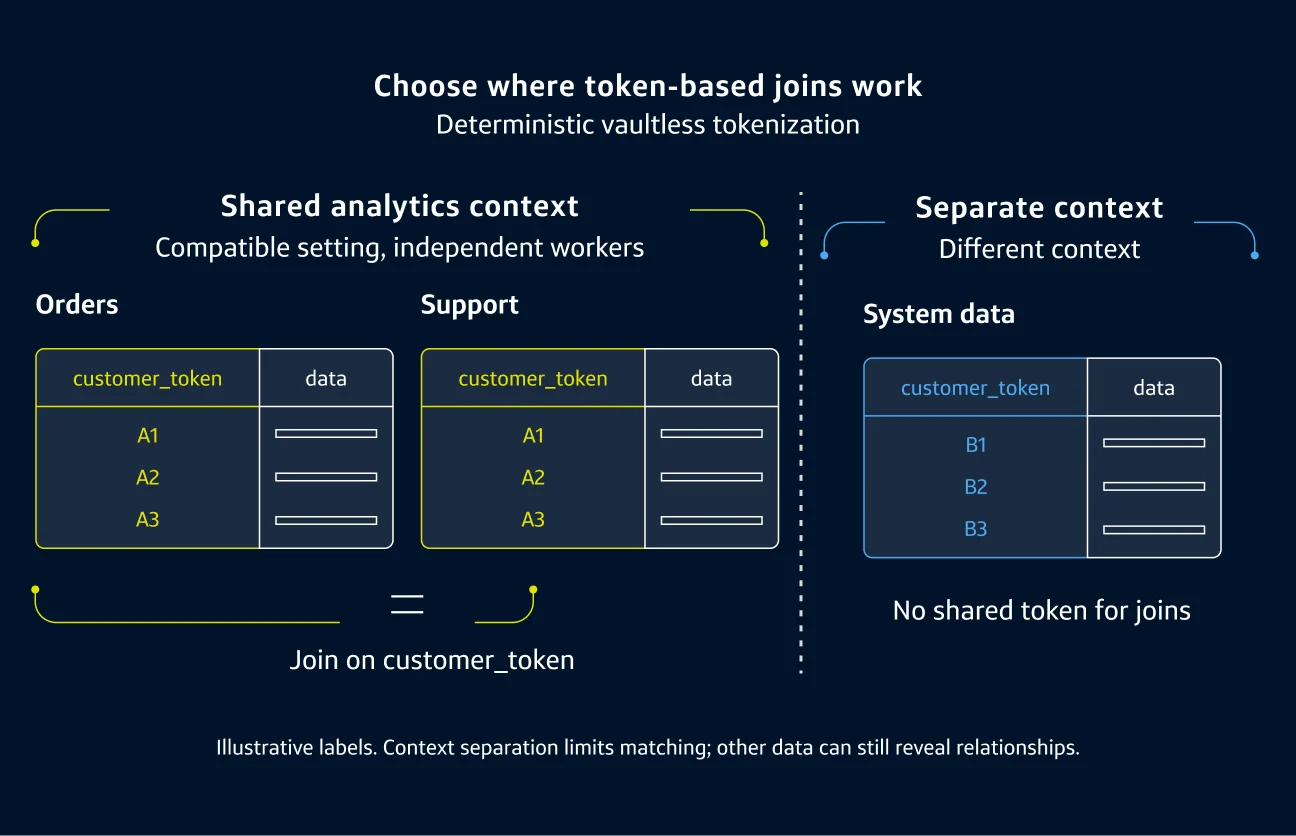
Figure 2: In this illustrative configuration, Orders and Support share matching customer tokens for equal normalized inputs. A separate partner context produces different tokens. Shared transformation settings and material versions enable the intended joins, context separation does not eliminate inference from other attributes.
Conclusion
For a platform that needs to protect data across pipelines, regions and large processing jobs, start the evaluation with a vaultless tokenization solution, like Databolt. It removes the work of maintaining individual recovery mappings and allows protection to run near the workload for optimal throughput. It also removes the burden of storing, indexing, replicating and protecting an ever growing mapping store, as well as the overhead associated with key management.
Here’s a summarized comparison to help establish if any specific requirement justifies adding that mapping state back.
| Requirement | Databolt’s vaultless tokenization | Vaulted tokenization solutions |
|---|---|---|
Add new values | Compute tokens without creating per-value mapping records | Create and retain new recovery associations, with indexes and retained copies |
Generate compatible tokens across workers | Use compatible inputs, material and configuration | Resolve or create associations through the mapping architecture |
Expand across regions | Deploy workers and govern configuration, material and access | Extend shared access, replication or partitioned ownership of mappings |
Keep recovery available | Retain and protect transformation capabilities and versions | Retain, protect and serve the required associations |
Retire an individual association | Manage exclusions via access policy or an external blocklist | Remove or disable the association and propagate the change |
Govern recovery | Enforce policy, protect cryptographic custody and audit operations | Enforce policy, protect mappings and their encryption and audit operations |
A vault remains a deliberate choice for applications that need independent management of token associations.
Distributed analytics and AI workloads have a broader need: consistent protection wherever processing happens, without a growing mapping store to maintain and coordinate. Databolt addresses that need by removing per-value mapping storage while allowing teams to govern distributed execution through configuration, custody and policy. That architectural advantage is the reason to favor it, then validate the implementation against the workload.
We recommend you evaluate any potential vaultless tokenization solution on a representative pipeline or backfill. Confirm that matching identifiers remain usable across the required systems, measure throughput with production controls enabled and demonstrate the recovery restrictions the workload needs. Use those results to establish how vaultless tokenization can support the wider data platform. If you’d like to learn more about Databolt and how we can help you with your use case, book a call with the team.
Sachin Seth
Technical Writer - Product Marketing, Capital One Software
Sachin Seth is a data platform architect and analytics product builder known for his deep work benchmarking Databricks & Snowflake compute and delivering high-performance data applications at scale. He develops full-stack analytics solutions—ranging from billion-point time-series engines to portfolio optimization apps and real-time financial dashboards—blending Databricks, Snowflake, Rust, Arrow and modern web technologies. He writes to bring clarity, measurement and engineering rigor to the rapidly evolving world of Databricks & Snowflake and modern data platforms.
Footnotes
DISCLOSURE STATEMENT: © 2026 Capital One. Opinions are those of the individual author. Unless noted otherwise in this post, Capital One is not affiliated with, nor endorsed by, any of the companies mentioned. All trademarks and other intellectual property used or displayed are property of their respective owners.